Saturday, 13 February 2021

First HOTT of 2021

The excitement of doing HOTT 52 last year has meant that I've been a little cold on playing it since, but I fancied something quick and easy this morning and set up my first game of the year.

I grabbed the first two boxes that came to hand and ended up with the Inca against the Army of Rama.

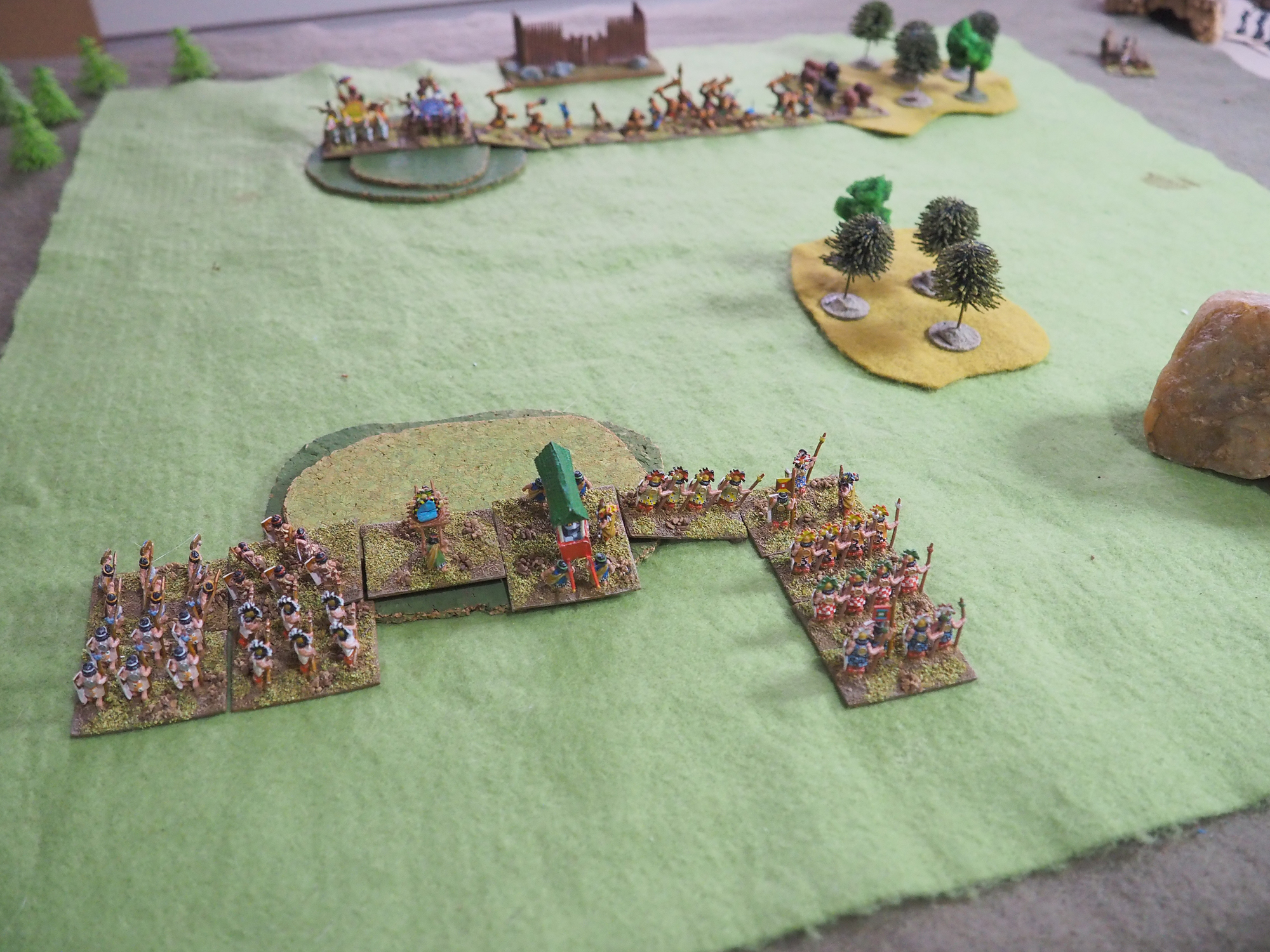
Rama defended, and being an army with a strong bad going component set up plenty of woods. The Inca were forced to attack on a narrow frontage. Here are the two armies, ready to go.


The Inca massed hordes on one flank, and their blades and the hero on the other.


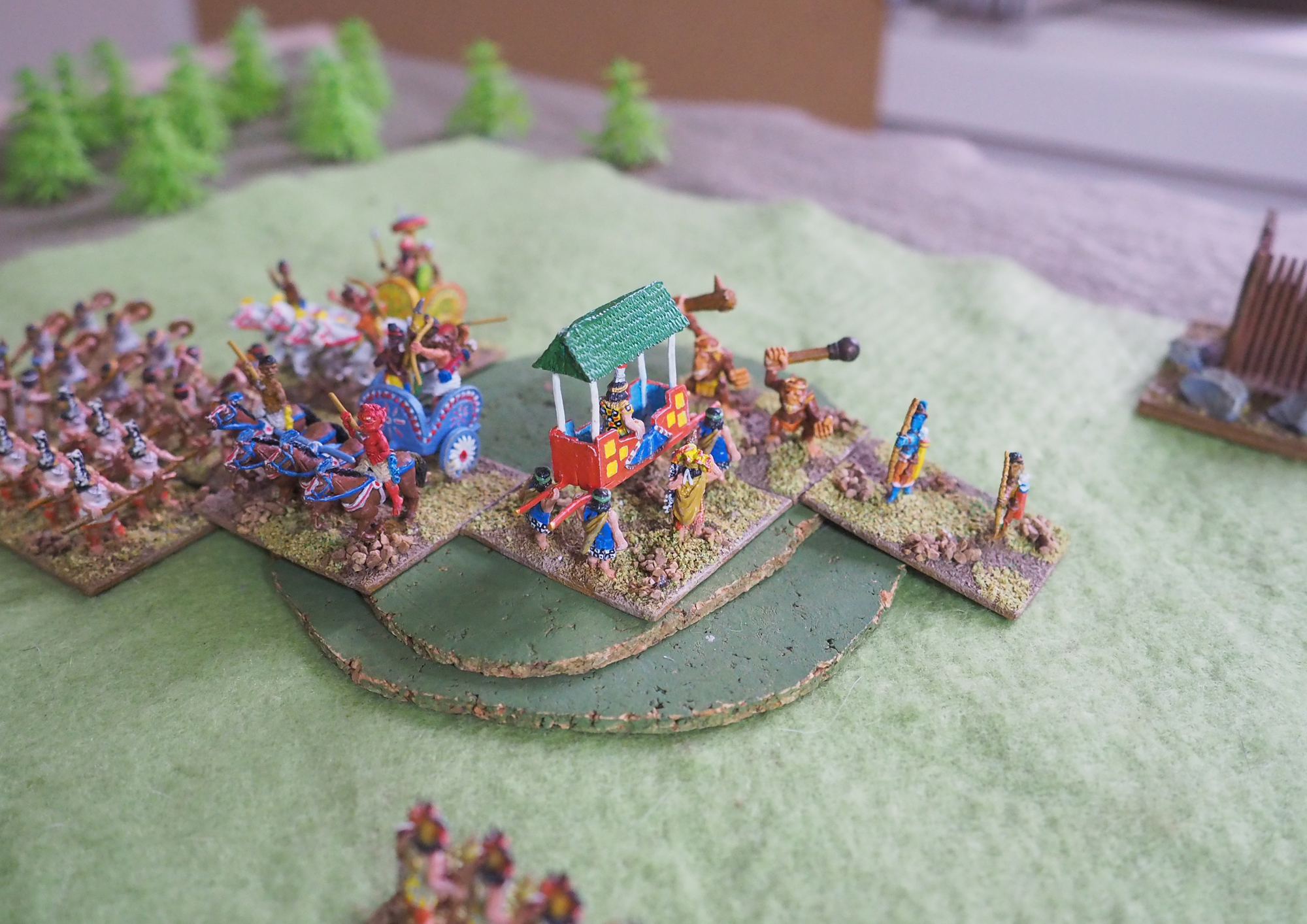
Rama could deploy on a hill. The heroes took the centre with the heavy chariots on the hilltop. The warband and beasts were in and opposite the woods, ready to outflank the Inca.


The Inca had one surprise ready - Amazonian Indian lurkers. They attacked some bears and destroyed them.


Some of Rama's monkey warbands moved quickly to disrupt the right flank of the Inca. The deep column would be forced to spend several bounds redeploying in response.


But the rest of the Inca army pushed forward, hoping to use their numbers to take out Rama's centre.


An overview of the early stages.


As the Inca approached, Rama attacked down the hill. Results were mixed, but importantly the hordes held.


The Inca on the right flank got themselves organised, pushed into the woods and drove off Rama's monkeys.


On the hill the chariots were fighting well, and Rama forced some Inca warriors back, but the Great Inca in his litter was driving forward against Hanuman and Sugriva.


One of the chariots was swamped by Inca hordes.


The Great Inca ended up in trouble - isolated and attacked front and flank. But he fought his way out of it.


An overview of the battle. The Great Inca was driving forward on the hill, the hordes were moving in on the second chariot and in the centre the surviving warband and bears were fighting the Inca regulars. 


The second chariot was swamped by hordes.


And the Inca heroes took out the last of the bears. This won the battle for the Inca.


So the Inca won by a remorseless advance, and because the Great Inca just wouldn't lose any combats that mattered.

And it felt good to play some HOTT again.

Wednesday, 10 February 2021

Counterattack

I need to clear away my GNW figures so I can fiddle around with another project, but I thought I'd squeeze in one more game of Simplicity in Practice before I did so. I went for another OHW scenario, and rolled Counterattack. Afterwards I realised I'd played it with the same armies only a few months ago, but using a version of the Portable Wargame.

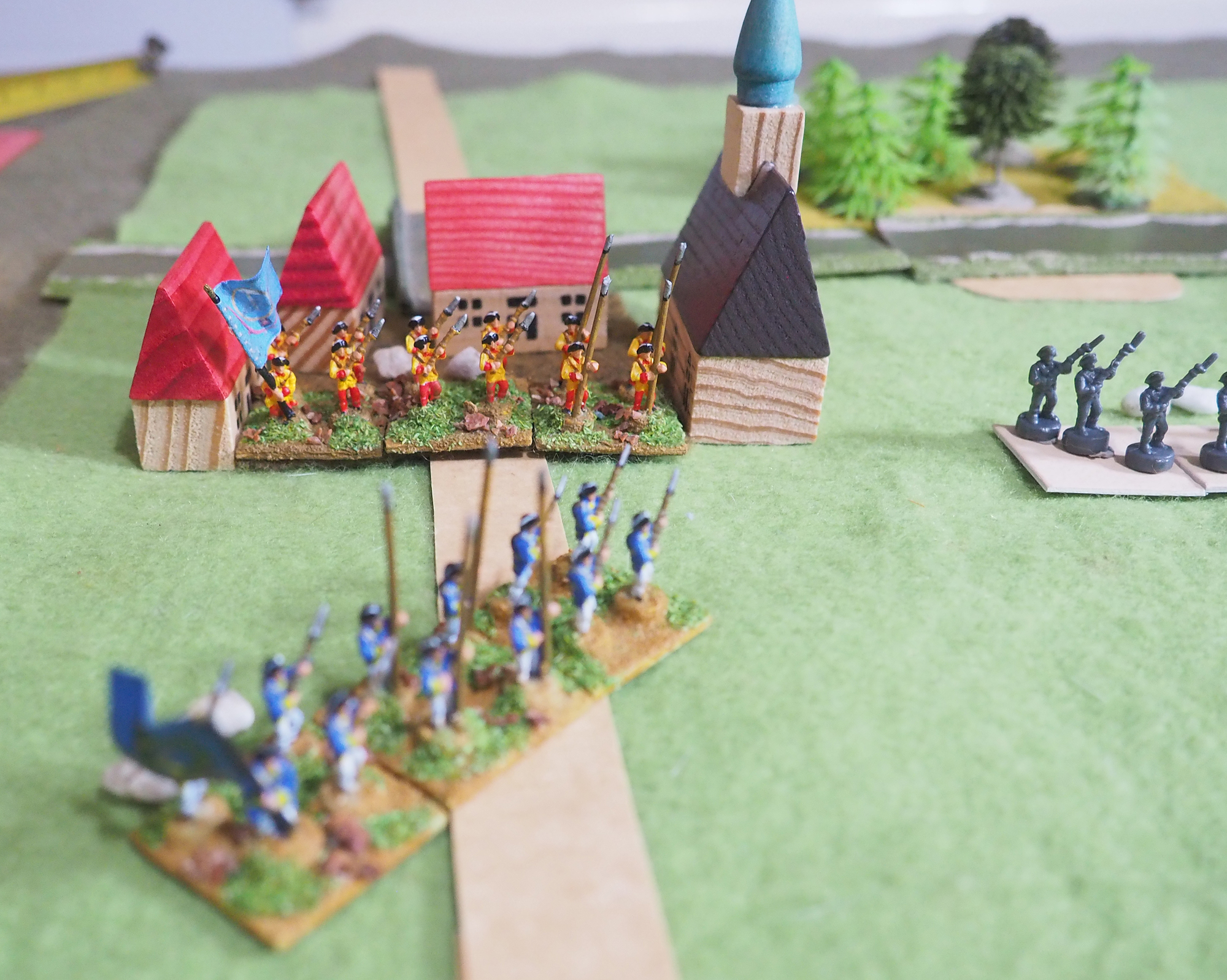
The Swedes had a single unit defending a bridge, whilst the Russians were massed around a village heading towards it.


Random events meant that the Russian advance got off to a slow start, but they soon got themselves organised to attack the bridge.


At that point the Swedes got reinforcements, and headed towards the fords on the flanks that the Russians nominally knew nothing about.


Both sides formed lines on their side of the river, looking to wear down their opponent before trying to force a crossing.


The Swedish defenders of the bridge were soon outgunned, and routed.


The Russian dragoons took a few hits.


The single unit left behind to guard the village against a sudden Swedish attack took even more hits, all from random events - they obviously found some barrels of brandy and opted to have a good time whilst their comrades were busy at the river.


The Swedes were losing the firefight across the river big time, so did a desperate cavalry attack across one of the fords. It was driven off.


The Swedes threw in more units to defend the bridge, but the Russian firepower was overwhelming.


The Swedish dragoons were routed.


And that really signalled the end of the battle. The Swedes had only managed a crossing with one unit, and that had failed, and the Russians had control of both the village and the bridge. The Russians took more losses from random events  than they did from Swedish fire.


This does seem to be a tricky one for the side counterattacking to win, since the 'defending' side can quickly set up a good defensive line against the river before the attackers turn up. I think the games I've played where the attackers have done best are ones with limited unit activations, where the defenders have to make choices about which of the three crossings they will send troops to. Maybe I need to restrict their movements until the counterattack turns up.

Sunday, 7 February 2021

Family Games

We got together with our friends this afternoon to play some boardgames.

Since we had a good turnout - right of us - we kicked off with 'Secret Hitler'. This is a hidden-role game, similar to Werewolf, with the players being members of a government split into Fascists and Liberals. Everyone is assigned a role at random - with eight of us there would be three Fascists and five Liberals. Each side is trying to ensure that their own board is filled with policy cards relevant to their allegiance. There are far fewer Liberal policies than Fascist ones, though, albeit that there are more Liberals to get them into position.

Two of the Fascists are just that. The third is Hitler. The two non-Hitler Fascists get to know not only which other player is Hitler, but who the other Fascist is and ho the Liberals are.

It's simpler than it sounds. Here are a group of people who are all definitely NOT Fascists. Oh no!


The role of President rotates around the table, and the President nominates a Chancellor. The other players then get to vote to confirm the Chancellor. If the vote rejects the nominee, the role of President passes around the table, but the country moves one step further towards an emergency. Go too far down that route and a policy is enacted at random, with the odds being that it will be Fascist. If the Chancellor is confirmed then the President and Chancellor get to draw policy cards and enact one (place it on the board).

Here President Satvik takes a long, cool drink before selecting his Chancellor.


So how do you win? And where does Hitler come into it? Well, if a faction fills their board with their policies, they win. But, in addition, if at least three Fascist policies have been enacted, and Hitler is elected Chancellor, the Fascists win. So as the game goes on you have to be very careful who you select, or endorse, as Chancellor.

Because sometimes you elect ... HITLER


Early stages of our second game. The Liberals (blue) have two policies. The Fascists (red) have but one. Each policy after the first gives the President that round a special ability, regardless of their allegiance.  Early on these are to see the allegiance of a selected player (but not if they are Hitler), or choose the next President. Later on they can have other players shot, and removed from the game. The Liberals win if Hitler is shot.


So it's a game of bluff, lies and wild accusations, with one side trying to get the other to act against their interests, and one player (Hitler) trying to work out who their allies are and get themselves elected Chancellor.

We played three games. In the first we were really just learning the mechanics, and I was able to sit quiet as Hitler and quietly get myself elected Chancellor. In the second game the Fascists won by enacting all of their policies, despite the non-Hitler Fascists being shot. This is the final game, which went down to the wire but in which the Liberals deduced who the Fascists, and more importantly, Hitler were, and kept them out of the final round in order to implement the final Liberal policy for a win.


Three rounds of accusation and paranoia were enough for us. Two people dropped out for a rest, whilst six of us played a game of 'Marrying Mr Darcy'. Surprising no-one chose the two 'top' heroines (Lizze and Jane Bennet), so it was a fight between the supporting characters. 


I had the bookish Mary Bennet. I started off well, but my life descended into a whirlwind of terrible losses at whist and too much wine and venison, and I really failed to develop as a young lad of my station should. I was lucky to end up in a less than satisfactory marriage with Mr Denny. Not a disaster, but one that gave me only a middling score. Top of the table was Catherine, who used Charlotte Lucas ad built her up into a very eligible wife, easily securing the dull, but reliable, Mr Collins. Laura came second. As Lydia Bennet she failed to get a single proposal at the end, but ended up as a well-off old maid with much in the way of accomplishments, predominantly gleaned from her skills in manipulating people at parties.


Finally we all got back together for a family favourite, The Cat Game - Pictionary with a cat theme.


Once again we were treated to some terrible high-speed art, as the Perry Family fought the Saunders Family. It went down to the last round and only a point separated the winning Perrys from the second-place Sanders.

Here's my very obvious depiction of the activity 'Robbing a Bank'.


Saturday, 6 February 2021

One Hour Wargames - Scenario 23 - Defence In Depth

I'm still slowly working my way through, and reporting, each of the 30 scenarios in Neil Thomas's 'One Hour Wargames'. That's not to say that that I haven't actually played them all; this project was to formally do them all in order.

It's taken me about five years so far. But here I am at Scenario 23. In this one a force must cross a river and exit the other side of the board whilst negotiating unfamiliar terrain defended by a wily but numerically inferior foe.

Since I've been enjoying Simplicity in Practice with my GNW armies, I decided to use those and set it during the 1714 campaign in Finland. The Russians invaded this Swedish-controlled area and the Swedes, busy elsewhere, left the Finns to their own devices. The result was that after a few epic defences the outnumbered Finns were overwhelmed.

So this scenario sees a force of six Russian units advancing against a force of four Finnish/Swedish units. They must cross the river and exit the board by the road to the bottom-left of the picture.


The Russian force was rolled for normally, although I adjusted the outcomes to fit my troops and the period. They ended up with four units of close-order infantry, one of heavy cavalry and one of dragoons.


Their opponents rolled a four unit force, but had to replace two units with irregular light infantry, representing (for this scenario) militia or partisans. I apologise for them not being painted. I never needed any for Maurice - the rules my armies were assembled for - so didn't make any. But I am in the early stages of putting together another Risk-figure army which will use them, so had the unpainted figures stuck to bases in order to see how they looked. I used those.

Anyway, the defenders got one unit of Swedish close-order infantry, one unit of Finnish militia dragoons and two units of light infantry. The Swedish infantry was deployed in the village on their left, one unit of militia in a wood on the Russian side of the river and one covering the ford on the Russian right. The dragoons were held in reserve.


I used random events in this game, although no event would affect more than one unit. The Russians got lucky at the start, with their heavy cavalry getting a double move, which took them over the ford on their right and to a position to threaten the Finnish dragoons.


One unit of Russians advanced to wards the village, initially hovering out of musketry range, but forcing the Swedes to cover that line of advance.


The main Russian advance was on their other flank, as they organised themselves to cross the ford. The dragoons were the second to cross, the Finnish militia firing from the woods as they did so. The Russian heavy cavalry charged the Finnish dragoons, and threw them back.


The Russians kept up the momentum, routing the dragoons, and leaving the way to the exit point clear.


The Russian infantry at the village advanced now. It would lose a firefight with the village defenders, but it was obvious that if the Swedes stayed to defend the village they would lose the battle, as they were now needed to stop the Russian attack in their rear.


The Swedes began the slow withdrawal from the village, whilst the Russians pushed forward across the bridge.


Meanwhile the forward militia had abandoned their position, and fallen back to their side of the river, but found themselves caught in the open by cavalry.


As the Swedes withdrew from the village they were attacked by the Russians, but fought them off.


The Finnish militia weren't so lucky, and were driven back by a cavalry charge.


This was the position a few moves in. Russian infantry was reforming in the village, whilst the Swedes deployed on the road in order to block the Russian advance. In the centre the Finnish militia was firing at anything in range, and inflicting the odd hit here and there. The Russian cavalry was to the fore, although their dragoons had taken some casualties. Most of the Russian infantry was across the ford. However the Russian had to keep moving; infantry can be slow, and they had to exit three units from the board before the end of the game.


The Russians pushed the damaged dragoons towards the exit point as quickly as possible, followed by the heavy cavalry. All units were running a gauntlet of fire.


The Russians exited two units.


The Russian infantry in the village formed up and took the Swedes under fire, inflicting a steady stream of hits on them. 


Meanwhile the lead Russian infantry unit advanced to the attack. The Swedes were looking decidedly shaky.


But the lead Russian unit found itself caught between two fires and routed.


To add to the Russian problems, a random event saw the Swedes rally off one of their hits. They had to be removed to clear the Russian approach to the exit, so the Russians from the village charged. With a flank attack and more supporting units the odds were very much in their favour.

The Swedes won, routing the Russian attackers.


The Russians now only had two units left and had to exit one of them to win.


The rear Russian unit had a chance to finally drive off one of the militia units for good, but ammunition problems (another random event) saw them unable to fire.


The lead Russian unit charged - the Swedes were more disordered, but had support from the light infantry, so it was a 50/50 gamble.


The Swedes lost, and routed. The Russians' route to the exit point was clear.


Only the Finnish militia was left now, but the Russian rearguard finally sorted out its ammunition problems and drove off one of them. The remaining militia unit haunted the rearguard, peppering it with fire ...


... but only a random event could now stop the Russians from exiting their third unit, and it didn't eventuate.

So the Russians picked up a win, despite it looking a little shaky in the middle of the game. They generally got the best of the random events which, whilst they saw the Swedes get a rally at a crucial moment, also saw them take a few random hits throughout the game. The Russians got two double moves - the first allowed their cavalry to cross the river at the beginning, whilst the second allowed their infantry to attack in the village before the Swedes could properly form up. The Swedish defence could, with hindsight, have been better. The infantry would have been better deployed back from the village; they lost a lot of time, and risked an attack, defending and withdrawing from the village. Deploying the militia in the woods on the Russian side was a wasted move as well; the Russian can't cross at that point, because they can't enter the woods. The militia could have held the village instead, covering both approaches and leaving the cavalry and infantry as the strong second line.

I did make one small change to the SiP rules. Light infantry (the militia in this case) are very powerful, since they move almost without restriction, shoot fairly well and can combine the two things. They are vulnerable in melee, but are not totally helpless. Anyway, I ruled that if the moved before firing, or intended to move after firing (I'm not actually sure how that fits into the turn sequence) they only hit on a 5+ rather than their normal 4+. They can't have their cake and eat it.

Still, this was a fun game, and is in an interesting scenario. I see I have played it once before, using a variant of the OHW rules and setting it during the Mexican Adventure of the 1860s. You can read the report HERE.

Follow the rest of the scenario refights HERE

Related Posts Plugin for WordPress, Blogger...