Sunday, 12 April 2015

When Monsters Fight ...

... they get victory points.

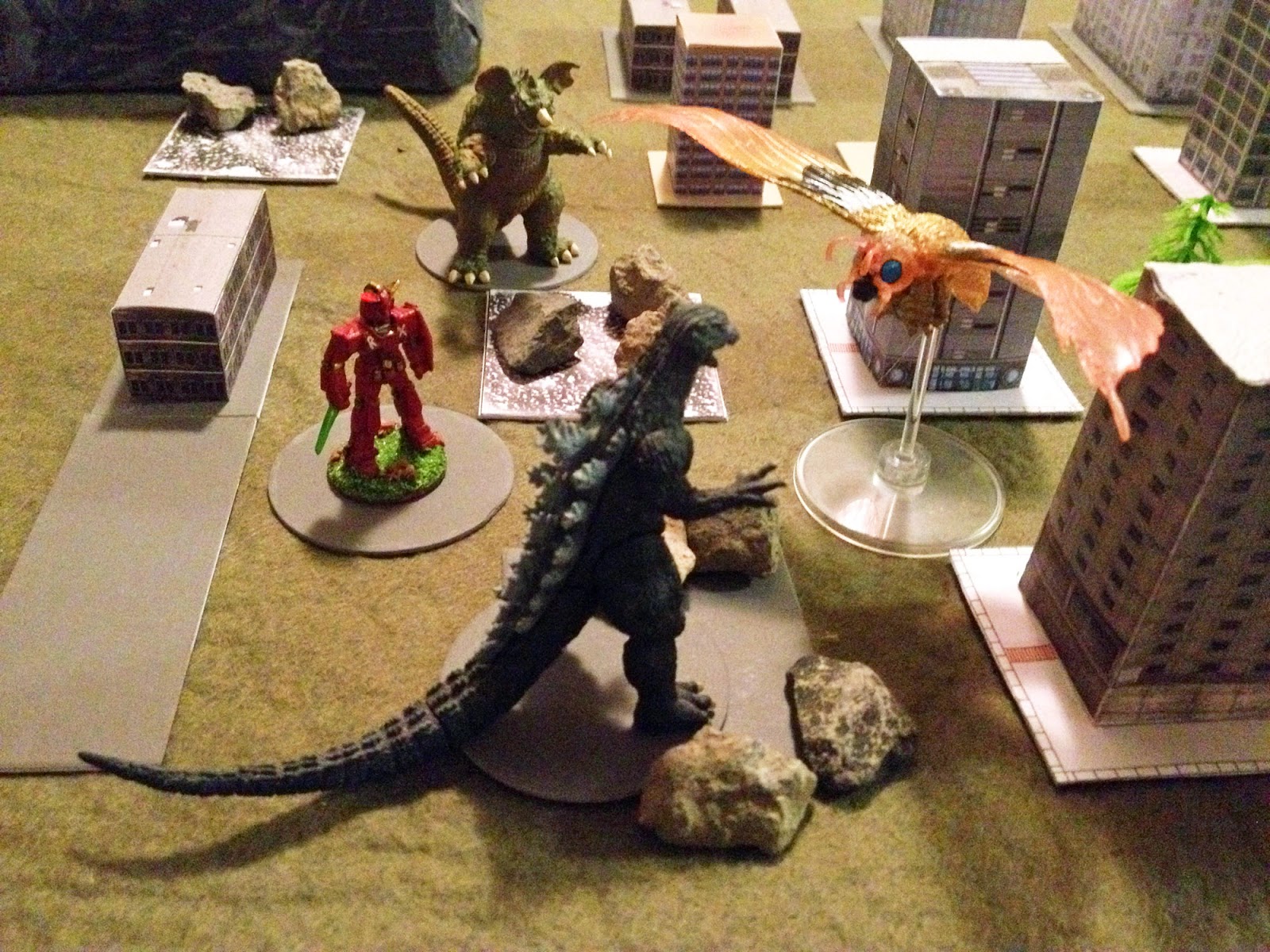
I've been playing some more games to try out my victory point system for 'Giant Monster Rampage'. Here's a few shots of one of them, featuring Godzilla and Gyaos as Attackers, Gamera as a Neutral Defender and Kiryu as an Active Defender. This game was important because it marked the first time - ever - that Kiryu managed to recharge its limited use freeze ray and get a second shot.

Godzilla faced Kiryu again. Based on a suggestion by the author of the rules as to a possible stratagem for attackers, Godzilla went on an all-out attack against Kiryu, whilst causing as much collateral damage to the city as possible. The two monsters beat each other up to within a couple of wounds of defeat.


Meanwhile Gyaos destroyed property (or at least damaged it) whilst using his agility to evade Gamera.


Kiryu almost took Godzilla down, but was defeated first. But Godzilla was totting up a good score, and Gyaos would be hard-pressed to keep pace. So Gyaos attacked Godzilla - if he could be knocked out, Gyaos could then concentrate on building his own score with only the easily evaded Gamera to worry about.


But, in fact, it was Gamera took down Godzilla. The King of the Monsters was on his last wound, and Gamera nipped in and ended his reign with a bolt of fire-breath. As a Neutral Defender, Gamera gets a bonus for scoring a KO on an attacker.


Gamera and Gyaos fought and chased each other ineffectually for the rest of the game, scoring a few points for wounds and buildings respectively. This pushed them slightly ahead of Godzilla. Had Kiryu scored the knockout blow it would have won, despite being the first monster to be defeated. Godzilla's score from destruction at that point was already considerable. As it was, Kiryu came last.


The system isn't perfect, but it does allow the monsters to adopt the 'correct' roles, whilst still forcing them to compete with each other. What I haven't tried yet is running pairs or teams of monsters, who add their scores together.

Friday, 10 April 2015

Quod Non Est In Tabula!

"A table does not have four legs"? No, that doesn't sound right ...

But, as they say, "Omnia dicta fortiora si dicta Latina".

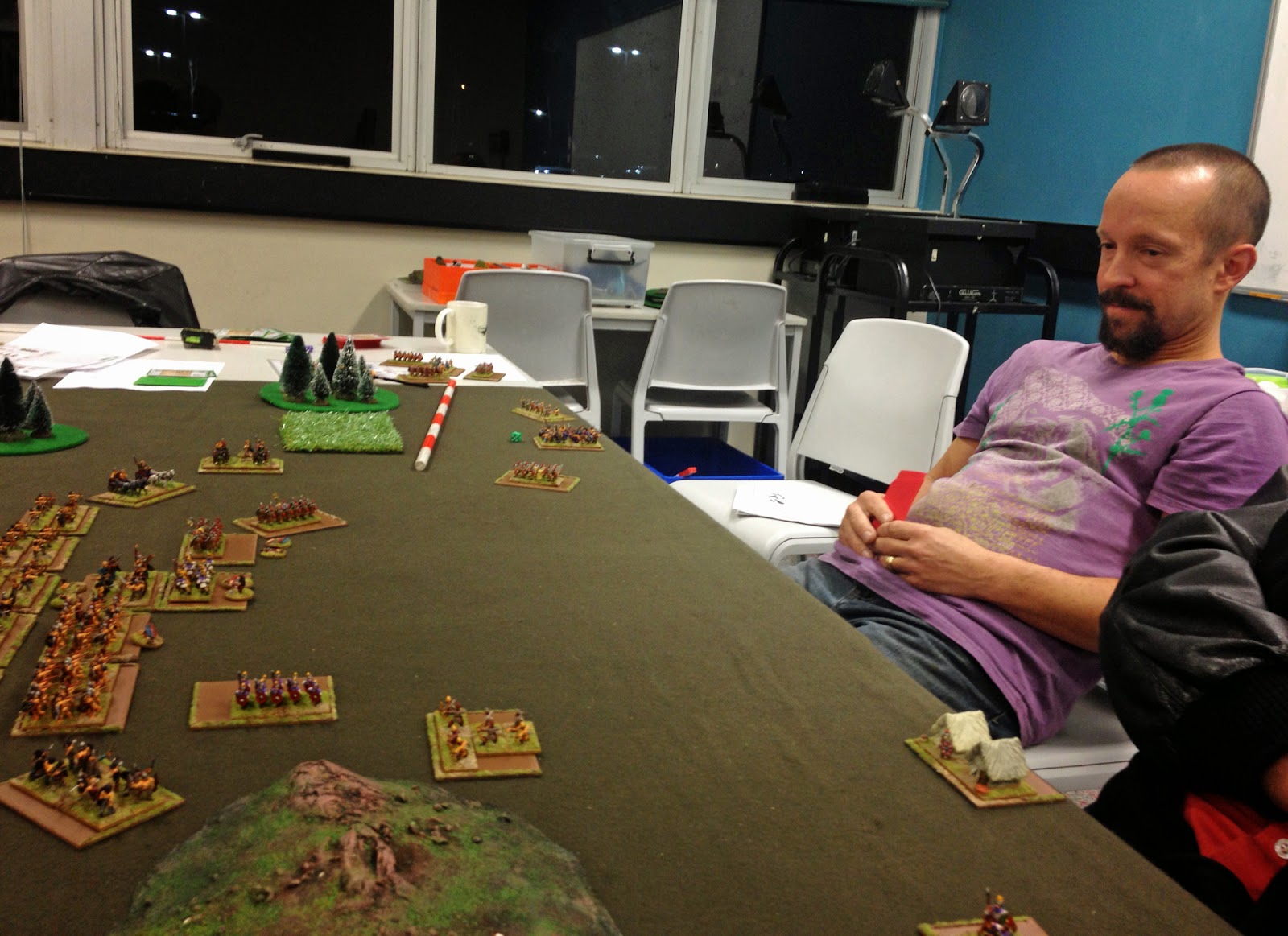
Anyway, Caesar and Gary were trying out a new ancients game last night, one about which I can't reveal any more information. But I can show you some pictures - Late Romans were fighting Germanic Barbarians (although the figures weren't entirely accurate with regard to that setup)

The armies lined up - Germans on the left and Romans on the right.


A cautious advance.


Light infantry and cavalry skirmish on the flanks.


The main lines close.


Towards the end - both armies have lost units by this stage.


The moment that Caesar realised that Gary had thwarted his plan to win on the very last turn ...


The game certainly looked interesting and played fairly quickly given that Caesar and Gary were having to look stuff up all of the time. There's some interesting mechanisms that add a bit of flavour and it's always good to see a game that goes to the very last turn with both players fighting to take one last victory point before the end..

Wednesday, 8 April 2015

Attackers And Defenders

The victory points system in Giant Monster Rampage gives monsters points for both inflicting damage on other monsters and for destroying buildings and other property. This is fine if your game is a free-for-all where all of the monsters are competing to wreak as much havoc as possible, but works less well in a game where one or more monsters is defending a city against an attack. This is a shame, as that kind of setup often tends to be the theme of a lot of films.

The problem is that defenders obviously shouldn't really score points for property destruction, but this then restricts their source of victory points to wounding other monsters. Attacking monsters are at an advantage because they have more ways to score points. The possibility of giving the defenders points for buildings not destroyed seems an obvious solution, but it requires a fine balance in  how many buildings you set up at the start of the game - too many and the defenders are obviously at a major advantage. In addition there are two kinds of defenders - those that are truly defending the city, such as military units or piloted mechs, and those that are really just defending it in passing whilst opposing monsters that are out to destroy. This second category covers Godzilla in a number of his films, plus monsters like Mothra and Gamera. They aren't concerned with how much destruction they cause, but it's not an aim; they shouldn't get points for it.

So the trick is to come up with ways of setting up a scenario which allows all types of monster a way of scoring points whilst maintaining their particular aims.

My idea at the moment is to categorise the three types of monster available in a game. These are:

Attackers - The standard monster, out to cause as much destruction as possible, whether on other monsters or on the city itself.

Neutral Defenders - These are monster that are indifferent to any property destruction; they aren't out to prevent it but gain no points for it. They are out to defeat other monsters, specifically Attackers.

Active Defenders - These are monsters that are seeking to stop the city being destroyed.

When setting up a game at least half of the monsters must be Attackers. The other monsters can be Attackers, Neutral Defenders or Active Defenders. The amount of destructible property should be based on how many potential attackers there are and how long you want the game to last. I usually play games to a turn limit, and would suggest a minimum of three building sections per turn multiplied by the minimum number of possible Attackers. So, for example, in a 10 turn game with four monsters at least two of them must be attackers, which would give 2 (monsters) x 10 (turns) x 3 = 60 building sections minimum. This should be more than enough.

Each type of monster scores points as follows:

Attacker
Score 1 point for each wound inflicted on any monster.
Score 1 point for each building section or equivalent they destroy.

Neutral Defender
Score 1 point for each wound inflicted on an Attacker or Neutral Defender only
If they KO an Attacker, score points equal to half of that monster's original Wound total (rounded up)
Score 0 points for each building section they destroy, but track the total (see Active Defender below)

Active Defender
Score 1 point for each wound inflicted on an Attacker
If they KO an Attacker or Neutral Defender score points equal to half of the points that monster scored for destroying buildings (rounded up)
Lose 1 point for each building section they destroy

The rationale for these points is as follows. Attackers just score points for damaging and destroying things. Nice and simple. Neutral Defenders get points for wounding Attackers, but also score for other Neutral Defenders. However they score bonus points for bringing down Attackers; these should be their primary targets. They get nothing for damaging Active Defenders, and nothing for buildings, but don't have to worry about damaging them in order to achieve their objectives. Active Defenders only get points for wounding Attackers. They lose points for damaging property, obviously. They get a bonus for bringing down destructive monsters - the more property damage a monster has caused, the more points they get. Note that whilst they don't get points for wounding a Neutral Defender, they do get the bonus points for buildings a Neutral Defender has destroyed if they KO one.

Attackers can avoid conceding building destruction points to Active Defenders by only going after other monsters. However buildings are a soft target; easier to hit and generally less tough, so are an attractive option.

I am testing these ideas out at the moment, and may need to tweak the balance, but it should allow for games where there are different agendas at play and in which the correct cinematic roles are maintained. Obviously it is aimed at  the traditional 'City Being Stomped' kind of game. Other scenarios would have more specific objectives.

Monday, 6 April 2015

The Original Battle For Mount Fuji

Yesterday I posted another of my One-Hour Wargames scenario reports, featuring a giant monster battle for the control of a cardboard-box Mount Fuji. What I didn't mention was that it was the second attempt I'd made at playing the game. I started one earlier that day, but abandoned it because it was just too fiddly and unwieldy to run and wasn't giving a fun game. But it did make for some nice pictures, so I thought I'd show some of them off.

The game differed from the one I played in that it included both Human army units and some Alien forces as well. I was interested to see how a game where both sides are a mix of swarms and giant monster would play out.

The JSDF had Valiant Monster Fighter, but the rest of their forces were all conventional - four swarms, consisting of nine Infantry, four Tanks, four Helicopters and three Jet Planes.

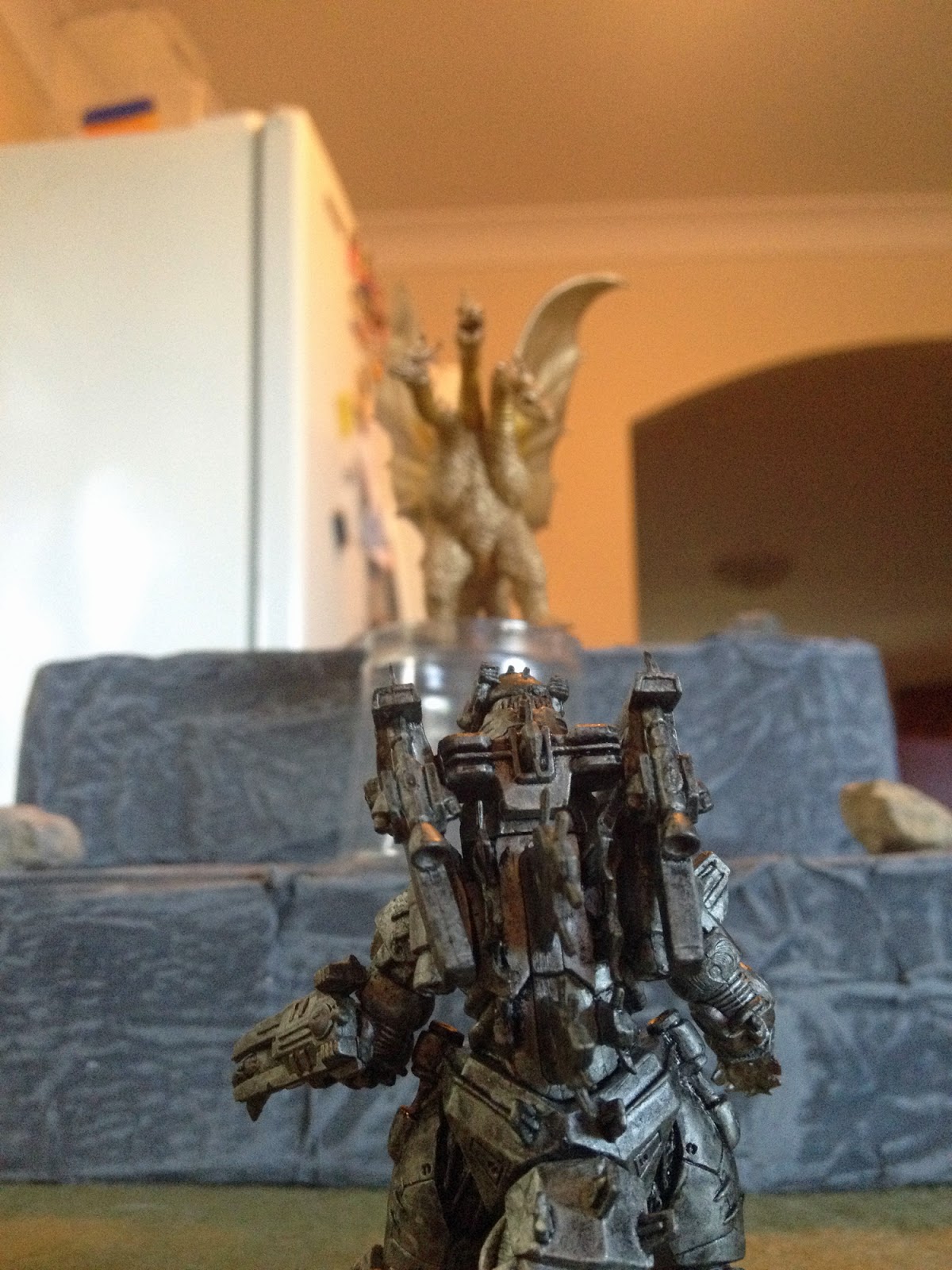
The Aliens had two giant monsters - Gigan and Ghidorah, but also had nine Infantry and four Tanks. Their stats were the same as the ones the Humans had; I didn't see any reason to complicate things by having special Alien Tank and Infantry stats. Not yet anyway.

In this picture you can see the Aliens set up. I used my hair-roller WW1 troops for the Aliens, although I can't see any futuristic army basing their tanks on WW1 British MkIVs. Can you?


The JSDF tanks and infantry made up the frontal attack force.


Valiant Monster Fighter and the air units were the sneaky flank attack.


Gigan was the monster bearing the brunt of the initial attack, although in fact only Valiant Monster Fighter went after him; the helicopters and planes went after the alien ground troops on the mountain.


Meanwhile Ghidorah went after the advancing JSDF troops.


More Valiant Monster Fighter vs Gigan action ...


The fight on the mountain between the aliens and the air units was inconclusive, although the tanks did shoot down a jet fighter.


The alien infantry suffered heaps of casualties from the advancing JSDF, owing to some good atomic power rolls, followed by some good shooting. They did better than Valiant Monster Fighter who couldn't make an impression on either of the alien units in this picture.


I gave up on the game about halfway through the third turn - it was taking too long to run and some of the interactions between the swarms didn't feel right. I think I need to try swarm vs swarm on a smaller scale first and see how it is best played, before trying it in a complicated game like this. However it was fun planning the game, and the cut-down monster only version I played afterwards was good fun, if a bit one-sided.

One-Hour Wargames - Scenario 7 - Flank Attack (2)

Or The Battle For Mount Fuji

The evil Xilians have established a base on Mount Fuji and are preparing to unleash Hideous Death. Japan - indeed the world - is doomed unless someone can prevent this. The base is guarded by three monsters, Ghidorah, Gigan and Space Godzilla.


Against them the JSDF can only muster Kiryu.


But wait! What's this coming in from the east? Reinforcements in the form of the Togusatsu hero Valiant Monster Fighter and Mothra.


The stage is set for Scenario 7 in Neil Thomas's One-Hour Wargames. I suspect that this isn't something he'd considered as a possible way of fighting it but I was in the mood for a monster game and the idea of merging it with my scenario project came to me in a flash of inspiration.

In this scenario one force is defending a hill against what appears to be a weak attack from the front. But a flanking attack is hard upon them. Victory goes to whoever controls the hill. Rather than six units a side, which translated to six monsters would make for an unwieldy game, I went for three a side. The split for the attackers - 1/3 frotal force and 2/3 flank attack - still works.

This is the actual setup.


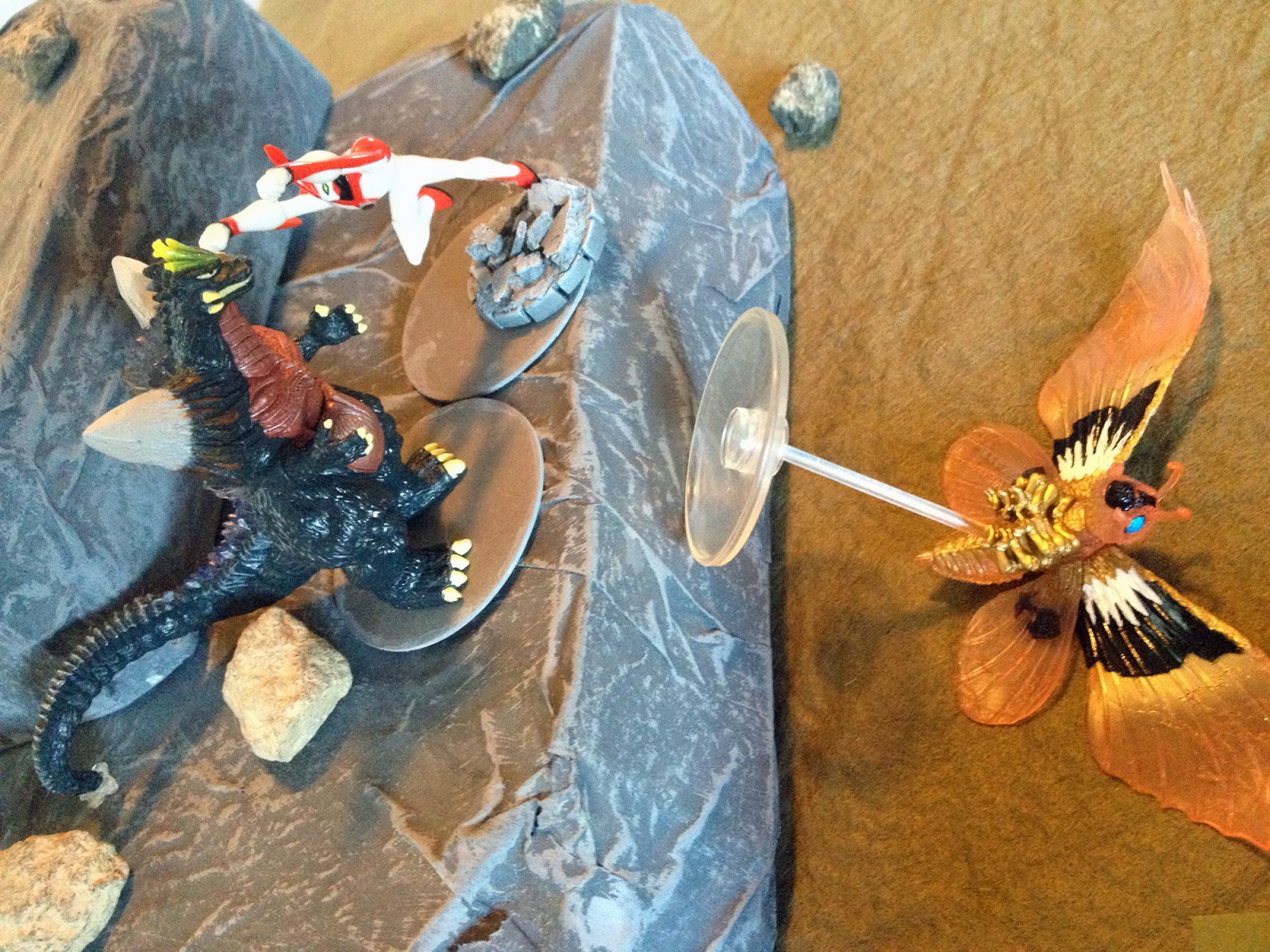
The heroes were straight off the mark, with Valiant Monster Fighter getting stuck into Space Godzilla using his awesome martial arts abilities.


Mothra has some powerful abilities, but had rolled badly for atomic power on the first turn, so couldn't make use of them. She opted to support Valiant Monster Fighter with close combat attacks against Space Godzilla.


Unfortunately Space Godzilla retaliated with a tail sweep which knocked Mothra out of the sky


He then turned, powering up his telekinesis ...


... and flung Valiant Monster Fighter off the mountain.


Before Mothra could recover, both Space Godzilla and Gigan were on her and she was blasted and sliced into defeat.

Less than one turn into the game, and the attackers were already down one monster.


Ghidorah moved to attack Kiryu, blasting it with lasers.


Kiryu retaliated, launching rockets, lasers and even the mighty freeze ray at Ghidorah, hoping to bring him down, or at least seriously damage him, as quickly as possible. The freeze ray hit, but Ghidorah resisted the damage..


Retaining the initiative Kiryu used its rocket packs to get in close to Ghidorah, and inflicted damage with its drill and blade.


Space Godzilla attacked with his energy blast, but couldn't use his telekinesis because Ghidodorah was in the line of fire as well.


Valiant Monster Fighter couldn't get back into close combat, but could use his energy drain on Space Godzilla. It had little effect however.


Gigan flew into the attack, and a titanic struggle ensued.


The end of the second turn - Ghidorah and Space Godzilla were putting Kiryu under pressure. Kiryu had used most of its expendable weaponry and was desperately hoping for the atomic power needed to recharge it. Valiant Monster Fighter and Gigan continued to fight.


Gigan got in some telling blows with his hooked claws, and then backed off before Valiant Monster Fighter could retaliate.


Ghidorah flew off the mountain in order to give Space Godzilla a clear shot at Kiryu with his telekinesis, but Kiryu launched a final volley of rockets ...


.. and knocked Ghidorah out of the sky. Turning, Kiryu then charged Space Godzilla ...


... and threw him off the mountain.


Unperturbed, Space Godzilla floated upwards ...


... and used telekinesis to hurl Kiryu across the battlefield.


This had used up all of Space Godzilla's power, though, leaving him open to an attack by Valiant Monster Fighter. He grabbed Space Godzilla ...


  ... and threw him into the nearby town.


Gigan returned to the fray. His claws had a longer reach than Valiant Monster Fighter's punches, and he made use of that to avoid retaliatory attacks.


Before Kiryu could recover, Space Godzilla rose above the town and used his energy blast to destroy the mechanical monster.


He then turned and mentally pushed Valiant Monster Fighter away from Gigan. Valiant Monster Fighter was now alone against three alien monsters.


He went back into the attack against Gigan who was the only opponent he could now reach. He inflicted hits and, amazingly, survived the return attacks.


Ghidorah recovered and re-entered the fray.


He positioned himself higher up the mountain, and used lasers to wear down Valiant Monster Fighter.


Valiant Monster Fighter saw a chance to score some useful damage on two monsters, and attempted to pick up and throw Ghidorah. But for all of his skill, he failed.


Before he got another change, Space Godzilla launched atomic energy at him, and he was down. The Aliens had won.


The game lasted five of the ten turns I had allocated to the game.


Launching the weak Mothra into close combat on the first turn was a mistake. She has some powerful abilities, but relies on decent atomic power to use them and should otherwise stay out of reach. Ghidorah resisting almost all of  Kiryu's freeze ray, and Valiant Monster Fighter's failure to throw Ghidorah off the mountain also contributed to humanity's defeat. Space Godzilla made full use of his range of abilities to cause general havoc and create openings for his allies.

The game was fun, but how did it work in relation to the original intent of the scenario? This seems to be to force the defender, who will be strung out along the hill facing one direction, to turn and face an attack from another direction, whilst the attackers have to keep up the pressure om the exposed flank. To some extent you got this on the first turn, with Mothra and Valiant Monster Fighter able to pile into Space Godzilla on the end of the line, but once everything else started to react became a much more fluid fight. There were movement effects relating to the mountain, but since all of the monsters bar one could fly and the one that couldn't could leap they didn't influence the game. Maybe some more ground-based monsters would have helped, making getting thrown off the mountain more of a disadvantage. I'd say that as a version of Neil Thomas's scenario it didn't really work, but as a scenario in its ow right - be the only side in control of the mountain, it has distinct possibilities. And that's part of the fun of this exercise with the scenarios; looking to see what works with them, and what doesn't.

Follow the rest of the scenario refights HERE
Related Posts Plugin for WordPress, Blogger...