Wednesday, 24 November 2021

An Even Fight

I threw together another game of 'Simplicity in Practice' today. I gave both sides the same forces - four foot, one gun and three horse, although I made the Russian horse dragoons and the Swedish horse heavy cavalry. I randomised the terrain, then deployed both armies. 

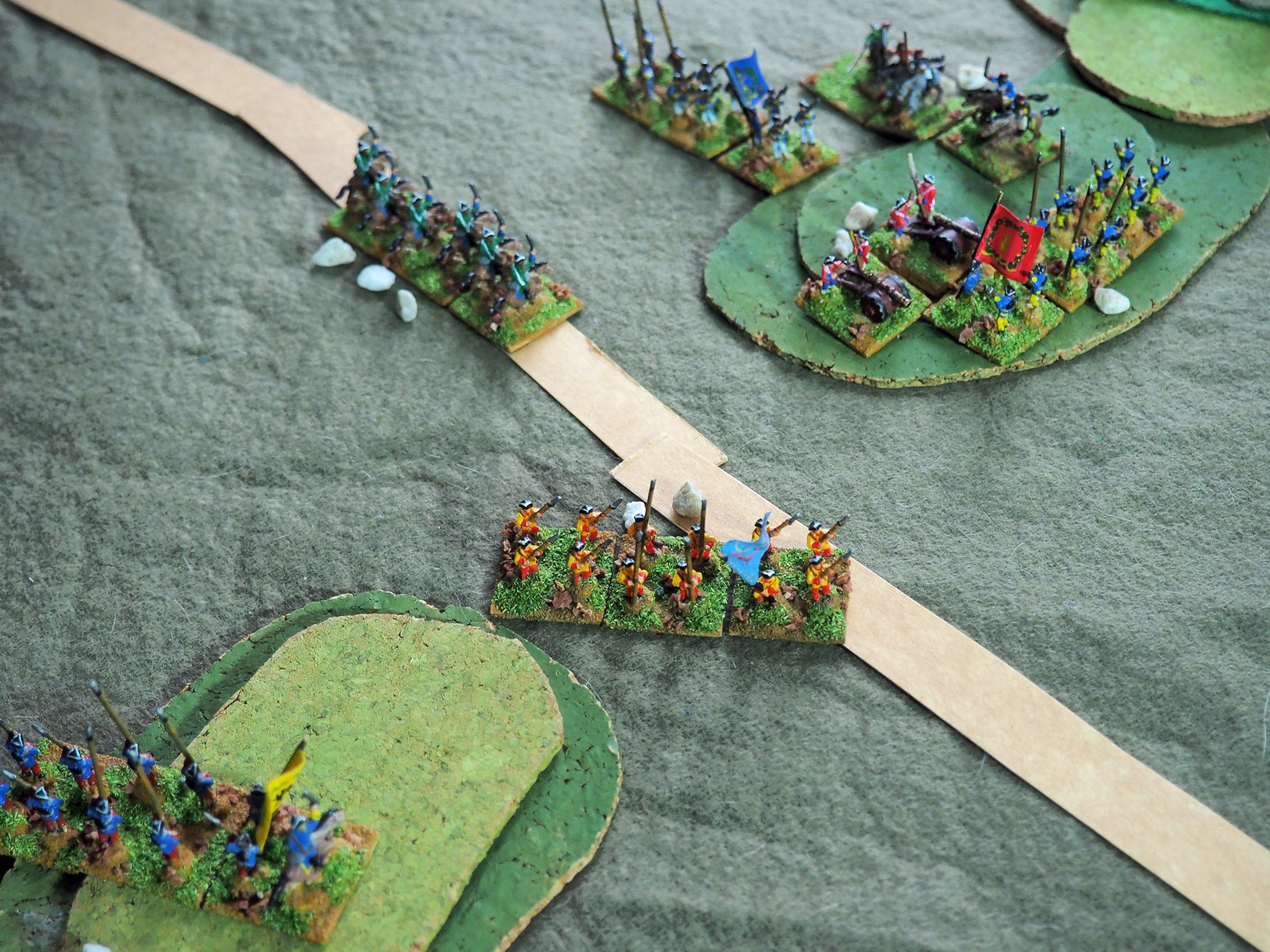
I decided to try an arbitrary orders system. I divided each force up into logical groups, created three 'plans' for each, then diced for what they'd do. Here's the opening move for each side. The Swedes in the foreground decided to advance their foot from the security of its protective terrain and attack the Russian centre. The Russians decided to hold in the centre, but outflank the Swedish right. The horse of both sides decided to sit tight, although that of the Russians would advance slowly to secure the flank of its infantry.


But what if it was obvious that your plan was, to put it simply, total bollocks? Easy. At the start of a turn you could change it. Unless you rolled a 1 or 2, in which case you carried on with the plan you had. The Swedish horse changed theirs, to an aggressive attack, and piled into the Russian cavalry, driving it back.


The Russians modified their plan to a more subtle envelopment, whilst the Swedes tried to adopt a defensive posture, hoping to bring their second line up as they did so.


On their left the Swedish cavalry polished off the bulk of the Russian horse, who'd taken a few pot-shots at the Swedes with no effect.


The Swedes settled into inactivity as they failed rolls to change orders. The firefight saw casualties on both sides.


The Swedish cavalry deftly changed their orders to a sweep across the Russian rear, and continued their bold ride. The last of the Russian dragoons disappeared, unable to retreat because of enemy units behind them.


Even some Russian foot was under attack now. Well-supported Swedish horse rode them down.


The Swedish foot slowly got their act together, moving to cover their flanks and add to the musketry. Both sides had now lost a unit.


The Russians were close to breaking. If their artillery was lost to the Swedish cavalry then that would be it. But it repulsed the first attack against it.


It didn't win the second attack, though. 


Two Russian foot units survived the action. The Swedes lost a single unit. 


I think that, possibly, the Russians need at least one unit of heavy cavalry to fight the Swedes on equal terms in melee. The dragoons can shoot but an aggressive charge can be on them before they get the chance, and melee is brutal in this game.

The order system was OK for a game like this, which would have otherwise been a solo stalemate caused by there being no obvious opening move for either side. I'm not quite sure how to formalise it, though. Or whether I either need to. Or want to.

Monday, 22 November 2021

Holding Action

I got out 'Simplicity in Practice' again the other day. I'd had a few thoughts about random events that I wanted to try but to be honest by the time I'd set up the game I'd decided they weren't really going to work, so I just played it straight.

I ran the first action from Grant's 'Scenarios for Wargames' - a holding action where one side must hold a pass against a numerically superior foe for the length of a wargames day, which I decided would be a nice 15 turns. The Russians drew the short-straw, and defended, with four foot, some dragoons and some artillery.


The attacking Swedes, with six foot, two heavy cavalry, a unit of light cavalry and some guns, came on via two roads, but ended up bottle-necked in a village.


The cavalry pushed through first, and began to form up.


The Russian artillery opened fire as they did so.


The Swedes moved their horse to face the Russian left, and formed up their foot against the right. More foot began to form up in the centre.


The Swedes put a bold cavalry attack together. The Russian artillery kept it under a steady fire.


As they closed the Russian foot joined in as well.


On the Russian left a firefight broke out between two forces of infantry, whilst the Swedish cavalry charged on the other flank, but were easily repulsed.


The attacking Swedes on their left were taking a fair number of hits as well. Things were looking good for the Russians; over halfway into the engagement and their opponents were already looking shaky.


On their right the Swedes withdrew their horse, and brought up their infantry reserve.


The Swedes tried a charge on the other flank, but were thrown back.


The Swedes went in on the other flank, and with more success. The artillery threw them back, but the Russian foot retreated, and the Swedes had made their first breakthrough.


Back on the other flank musketry did what cold-steel couldn't. Although the Swedes were battered they had worn down the Russian defenders, and two units were lost on the same turn, leaving a huge hole in the Russian position. Victory was now well within the Swedes' grasp.


And they seized it! They pushed forward rapidly and soon the Russians were down to three units trying to fend off attacks from all directions.


The Russian dragoons did manage a charge into the flank of some Swedish foot, but they were thrown back. The Swedes turned and a few volleys finished off the dragoons. 


The Russian troops broke and ran, with one last unit of foot holding the road through the pass. It was charged by cavalry ...


... and broke.

Although battered the Swedes had won a victory, clearing the pass with three turns to spare. Initially things looked really bad for them, as they lost a couple of units without inflicting much in the way of casualties on the Russians. But they slowly wore their opponents down, and once they'd created a few gaps the Russian position was lost.

In fact the extremities of each hill should have been rough terrain, which would have slowed and hindered the Swedish attack a lot more, so I'm not sure if I didn't give them a little bit of an edge. But it was a good game regardless.

Tuesday, 16 November 2021

South Sea Action

I gave my new South Seas vessels an outing last night, in a straight fight between the two factions I've painted them as, which for now are the Black Prows and the Yellow Prows. Both sides fielded the same forces - four catamarans and four groups of canoes. I'll post the stats below.

Here's the Black Prows, ready to sail into battle against their arch-enemies.


The position a few turns into the action. The terrain was a couple of islands and some reef (rocks). Shallows were not a concern since all of the vessels ignore them.


The Yellow Prows (top) advanced in a long line, whilst the black Prows tried to concentrate their forces in a column aimed at one of the Yellow Prow flanks.


The first firing saw casualties in a Black Prow canoe group. None of the vessels are armed in this action, so all firing is small-arms only. 


The two groups closed and missiles flew between the vessels. Both sides took more casualties.


The catamarans of both sides now closed up, and soon vessels were grappled together as the boarding actions began. Both sides tried to bring up canoes in order to outnumber their opponents.


An overview of the action. At the top and in the centre the Black Prows have catamarans that are fighting against odds of two-to-one.


The action becomes bloodier. The numbered counters represent damage to the vessels, and casualties were mounting on both sides.


By this stage, some ships and canoe groups on both sides had struck. In the close-packed melee, the victors were sometimes struggling to ungrapple and seek new targets.


A new melee breaks out to the south of the action, and both sides had sent flanking forces in that direction.


Although losses were mounting on both sides, the Yellow Prows just had the edge. At this stage, with the majority of vessels either struck, sunk or pretty much trapped I called the game.


I called it a draw but with the Yellow Prows gaining the greater honour. These are the surviving vessels - the Yellow Prows still had three of their catamarans active, albeit damaged. The Black Prows had lost all but one of theirs, but still had two active canoe groups.

As expected this action quickly became a series of close-fought boarding actions, with the victory going to whoever could concentrate their forces on the other or get the activations to seize the initiative. Ships breaking off from boarding actions after victory was an issue. A ship may cut grapples for free if the opponent has struck, and is then turned by the minimum amount necessary to clear its former opponent. However in many cases this would still leave them sailing into another nearby vessel. causing a collision, so staying grappled to their former foe was the only way to stay safe.

Despite those frustrations this was a fun little action. I now have an idea for a variant of it, this time with some gunnery involved.

Monday, 15 November 2021

South Sea Fleets

I finished off the new additions to my South Sea Islander forces for Galleys & Galleons over the weekend - six catamarans and six groups of canoes, as described in my previous post.

I did them with two subtly different colour schemes so that they can fight each other if required. Yellow bows on the left and black bows on the right.


In addition I made the catamarans on the one side all single-masted. I'm not sure about the sails on the two furthest and may redo them at some stage. The advantage of these simple scratchbuilds is that stuff like that is easy; I'm only dealing with card, paper and PVA.


Here they are with one of my medium galleons for scale.


One small issue is that since I last did any prints of the sea-texture I use for the bases, we have a acquired a new printer, replacing our old inkjet with a colour laser printer. And the colour reproduction of this new printer is a lot better, as you can see from the brighter bases of the new models compared to the four older ones.

I didn't make any more outriggers (as shown in the last post), but may do that as my next project.

Thursday, 11 November 2021

More Catamarans And Canoes

Back in 2019 I shared how I'd made some South Sea canoes and catamarans for Galleys & Galleons. I said in the post that I'd look at expanding my fleet, and today, a mere two and a half years later, I made a start. 

I'm making six more bases of canoes and six more catamarans. That will give me a total of eight of each, which I can split into two forces.

I also mocked up a design for a large outrigger vessel.


The stats I've used for these vessels in the past are:

Catamarans - Q3 C2 - Lateen Rigged, Unarmed, Intimidating, Shallow Draft, Sweeps (24pts)

Canoes - Q2 C2 - Boats, Intimidating (28pts)

I'd run the outrigger as a catamaran, drop it to C1 and give it the Razee trait. I'd possibly consider giving the catamarans and the outrigger the Yare trait as well (making them 28pts)
Related Posts Plugin for WordPress, Blogger...