Tuesday, 19 November 2019

The Battle of Pacocha

In 1877, a revolution in Peru saw the ironclad naval vessel Huascar taken over as a raiding vessel by the rebels, and used to harass local merchant vessels. This all went well until they boarded a couple of British ships. Obviously the British weren't going to let this affront to Imperial dignity pass unpunished, and dispatched two naval vessels to capture the Huascar - HMS Shah and HMS Amethyst.

The ships exchanged fire, and the British ships took some damage. The armoured Huascar was pretty much unscathed, outran the Royal naval vessels. However the rebels surrendered it to Peruvian authorities a couple of days later.

I set up this brisk little action for Galleys & Galleons., using the following stats:

Huascar - Q3 C4 - Steam Engine, Ironclad, Charismatic, Gun Turrets, Veteran NCOs, Trained Gun Crews,Yare (104)

HMS Shah  - Q3 C4 - Steam Engine, Chaser Guns, Trained Gun Crews, Carronades (62)
HMS Amethyst - Q3 C3 - Steam Engine, Chaser Guns, Trained Gun Crews (48)

I piled abilities onto Huascar in order to even the fight. At least one account suggests that Huascar could turn very quickly, so I gave it Yare. I added Veteran NCOs to make it harder to board. And Charismatic was added simply to give it an aura of piratical unpredictability.

HMS Amethyst I set up as a basic vessel, with a lower combat rating than Huascar. HMS Shah was bigger and much better armed, and I made it equivalent to the ironclad in firepower. The Carronades represent that fact that HMS Shah was armed with early torpedoes.

All ships were given Trained Gun Crews to reflect them being well armed with rifled artillery.

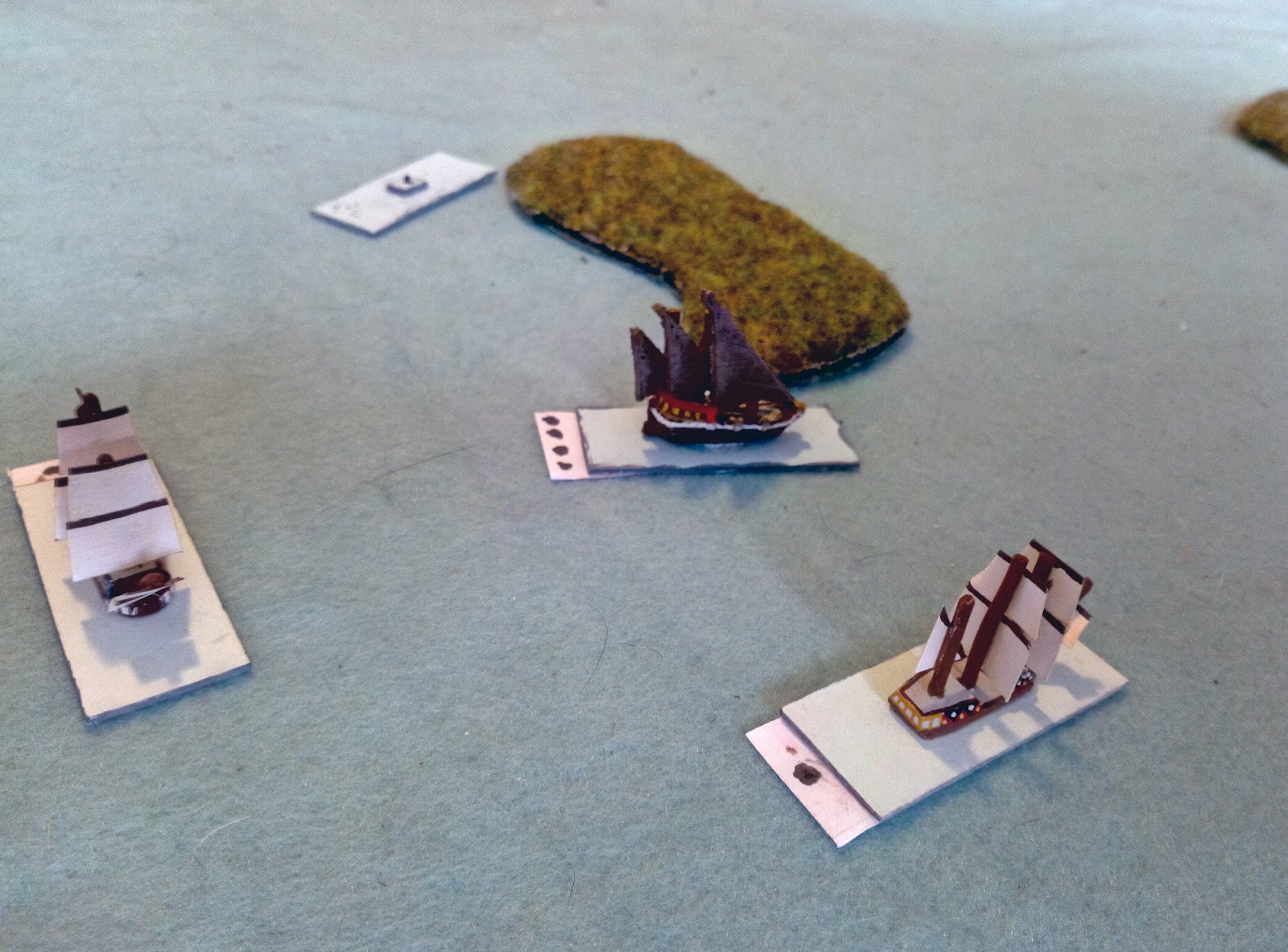
Many years ago I scratchbuilt models of all of the major vessels from the 1879 Pacific War between Chile and Peru, including the Huascar. I can't find them now. I haven't seen them for years, in fact, so I suspect they got chucked out, accidentally or deliberately, at some point. Anyway, I used proxies from the ACW naval collection instead. Huascar was played by the monitor USS Weehawken, HMS Shah by the USS Hampton and HMS Amethyst by the USS Kearsarge.


I ran the game as the standard pursuit scenario. Huascar has to get from one corner of the table to the opposite. The Royal Navy has to stop it. I randomly created some terrain; two small areas of shallows and a a small island ended up along one board edge, and played little part in the game.


The Royal Navy started in the opposite corner of the table to Huascar, forcing the rebel ship to run the gauntlet of their fire.


The Shah and Amethyst approached the Huascar towards the centre of the table; Huascar fired the opening shots, scoring no damage.


The Royal Navy vessels diverged, to bring two broadsides to bear on the Peruvian ironclad.


Huascar fluffed a series of activation rolls, missing an opportunity to pass across Shah's bow and deliver a devastating rake. Instead the ironclad ended up running alongside the Shah, and took a full broadside, which damaged its bridge, seriously wounding its captain and senior officers.


From then on the Huascar struggled to do much each turn except either fire, or correct its course. Its firing was wild, and it failed to inflict any damage on the unarmoured British vessel. The Shah turned about and took the Huascar under fire again, causing dome engine damage. But the Huascar's speed remained unaffected.


What of HMS Amethyst? The smaller naval vessel had had trouble turning about after its initial pass of Huascar, and was now well in the rear of the pursuit, taking no further part in the action.


Huascar was still running for safety, despite the damage it had taken. The Shah got in close for one more broadside/torpedo launch, but the Huascar was unscathed, and escaped into the darkness.


Although the Huascar was fairly badly damaged, it had escaped, so this counted as a reasonably convincing win for the Peruvian rebels. Shah did have the option of deliberately colliding with Huascar on the last turn, but I decided this was a risky (and somewhat dishonourable) move. Unfortunately there weren't the actions to do a turn and grapple, in order to halt the ironclad and possibly take it by boarding. The Royal Navy took no damage.

This was a quick game. Despite the Huascar being hit quite convincingly a couple of times, it was able to escape with little difficulty. Different terrain, and a bit of luck on the part of either side could have seen a radically different and (frankly) more interesting game.

Saturday, 16 November 2019

An Elizabethan Entertainment

Four nobles at the court of Good Queen Bess have each wagered that their personal yacht is the fastest in the kingdom. Obviously there's only one way to determine the winner - a race!

I thought that it would be fun to try a non-combat scenario for Galleys and Galleons, and a race seemed the obvious choice. I decided that there would be no combat, so the C values of each vessel are irrelevant. I made a list of suitable traits for racing, and then built four different designs - the lower a vessel's quality, the more points it had for traits*.

The four yachts (numbered with dots):

1 - Greyhound - Q4 - Galleon Rig, Razee, Shallow Draft
2 - Caroline - Q3 - Galleon Rig, Pilot, Sweeps
3 - Minnikin - Q3 - Square Rig, Charismatic, Pilot, Yare
4 - Levant - Q2 - Lateen Rig, Shallow Draft, Sweeps, Yare

And here they are on the starting line.


The course was a figure-of-eight. The first pass between the islands would be with the wind, but one the ships rounded the farthest island they would be working against the wind. Assuming, of course, that the wind hadn't radically changed direction in the meantime.


And they're off. As anticipated, Greyhound immediately pulled ahead, with its Razee ability giving it a real edge. But it's lower Q value meant that once maneuver was needed it would be at a disadvantage. Levant lagged behind; running before the wind wasn't its best point of sailing.


Having drawn the outside position, Minnikin was struggling to get up with the pack, which also limited its expensive Charismatic ability (which intimidates other nearby vessels and reduces their Q value). Greyhound continued to pull ahead, followed by Caroline.


Levant's shallow draft allowed it to shave close to the first island, and turn to  better point of sailing. Minnikin continued to struggle.


And now the tricky bit - the first tight turn which would allow the vessles to then run across the wind on the far side of the island and get into a good position for the tack at the other end. Greyhound began to stumble here; built for straight line speed turns were not really its forte. Caroline stuck close to its stern. Levant carefully turned into position; with a shallow draft it could cut close to the island with no risk, and its Yare ability meant that it could turn better than some other ships.


Greyhound turned slowly, forcing Caroline to veer away in order to avoid a collision. Even Minnikin was catching up now.


Greyhound pulled ahead again. Caroline faled to turn and Minnikin risked the shallows. Levant looked blocked by other vessels.


But if there's one thing Levant can do, it's turn. Its helmsman swung the little ship hard to port and it flew through the gap between Caroline and Minnikin.

(I used random sequencing based on cards, and this was the result of a fortunate piece of timing with regard to the order of movement.)


Unfortunately Minnikin failed to react, and collided with Levant, ending up badly damaged. Levant escaped with a few minor scratches.


Caroline was still making heavy weather of the turn. Levant turned broadside on to the wind and sped away, in pursuit of Greyhound. Minnikin was now moving through the shallows; already damaged from the collision, it hit a rock, and foundered.


So now there were only three vessels left in the race. Greyhound was still out ahead, but was now trying to tack for the second pass between the islands. Levant angled for a closer pass around the island.


Caroline moved up slowly, but was still messing up its turns. Greyhound tacked but the more nimble Levant was rounding the island and tacking more quickly. In addition it deployed sweeps, enabling it to move even into the wind, albeit very slowly.


Levant edged into the lead! Caroline's slow turns meant that it was now pretty much out of the running.


Levant and Greyhound reached the far side of the first island. Levant shaved it close; a slight turn as it cleared the land would angle it nicely for the finish line. Greyhound had ended up wider, and was now in trouble; a tack to starboard would end up with it sailing dangerously close to the island, but it couldn't make a forward move whilst in irons.


A small shift in the wind helped Greyhound, allowing it to close haul round the island. This brought it close to Levant. Greyhound was once again in a bad position; the wind meant that it would have to pass between Levant and the island, but there wasn't room. To turn the other side of Levant would mean going into irons again. The only solution was to stay on course, and collide with the Levant. Both ships took damage, which would make the final Quality rolls to finish the race riskier.


The finish line was now in sight, and both ships were lined up to cross it. Levant was ahead, but if Greyhound could get a better angle it could maybe use its Razee ability to outrun Levant.


I'd decided that if two ships crossed the line in the same turn, then the one that went furthest past would win. Levant sailed as fast as allowed. But Greyhound made the necessary course change ..


... and cut inside Levant. Both ships crossed the line together!


The Queen was forced to deploy the Royal Laser Pointer. It determined that Levant had won, by the length of a forecastle.


Caroline came a distant third.


This was great fun to play. Galleys & Galleons using fixed distances for sailing, which I thought might be an issue for racing, but the vagaries of the action system meant that when a  ship was able to turn was also very important. Greyhound had a real advantage in the straight line race, but Levant was able to exploit its extra turn ability and took the lead thanks to being able to use sweeps when both ships were turned into the wind. Levant's superior quality helped as well; on a couple of turns Greyhound had to choose between boosting its move or turning, because its low Quality left it with only one action.

An interesting fantastical race could be had by adding in the other movement options in the game - galleys (historical, there), but also ships with steam engines or unorthodox propulsion.

*If you're interested, a Q4 vessel could spend 13 points on traits, a Q3 10 points and a Q2 8 points.


Friday, 15 November 2019

Gaslands Refueled

I finally have my copy of 'Gasland Refueled'!

What's that? well, it's the vastly expanded and revised version of Gaslands. It covers everything the original game had, plus all of the material from the for Time Extended supplements, plus some entirely new stuff. And it's been revised to deal with issues of balance as well as to clarify some of the murkier bits.

What's in it? Well, the basic game is unchanged. The rules are better explained though - it takes you through the absolute basics of mvement first, then shooting, and only then introduces collisions and the other tricker stuff. Finally it finished up with the different vehicles and weapons types, plus old and new sponsors and perks. There are several well -diagrammed and well-explained examples of play covering some of the areas of the game that weren't entirely clear in the original.

A lot of the weapons have been tidied up; for example, rockets are no longer as deadly as they were, there's a point to buying mines in stead of caltrops. A few new ones have been added. All of the old sponsores are there, plus the two from TX and five ones new to this volume. In addioton a few perk classes have been revised and some new ones added. There's plenty of scope for interesting teams, including one made up of haunted vehicles.

The six original scenarios are in the game, plus a few wasteland skirmish scenarios and some new special ones (hunting giant radioactive monsters for example). There's also the campaign system from one of the supplements.

The whole thing is packed in a sturdy hardback book.

If you like Gaslands then this is the game you remember, improved and expanded. The new stuff almost entirely adds to what was there before, rather than radically changing it. I'm looking forward to giving it a spin.


Thursday, 14 November 2019

Icebergs

'Fayre Winds & Foul Tides' is the supplement for 'Galleys & Galleons', and includes all kinds of fun stuff for expanding the game. Some of it is more fantasy or 'lace-pulp' orientated, but much of it can be applied to regular games. One of the sections covers special terrain pieces - volcanoes, areas of weed, maelstroms and ... icebergs. I'd not tried the iceberg rules before, so last night I set up a game to use them.

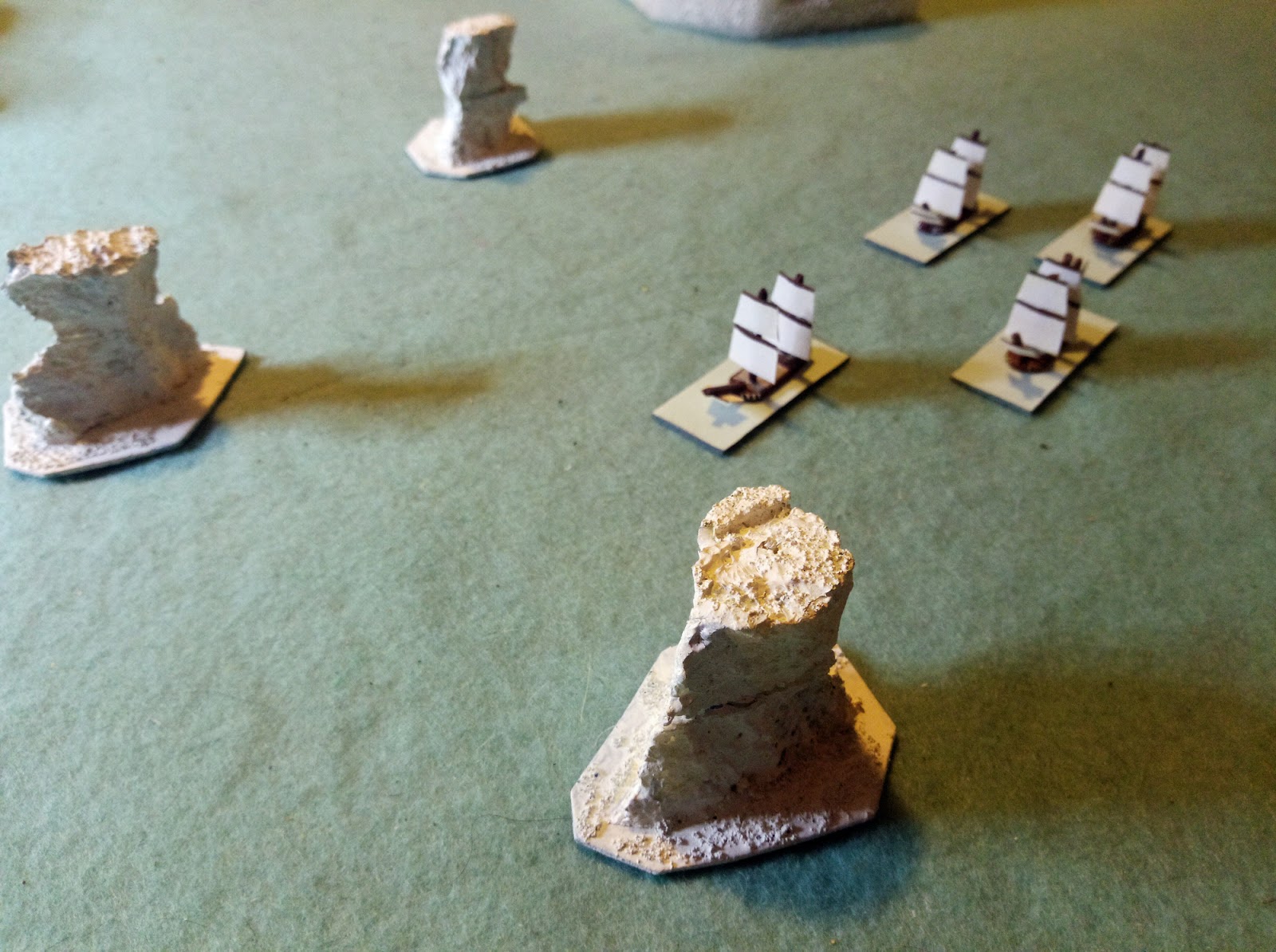
I have a selection of ice terrain pieces which I made for some of my HOTT armies many years ago, so dug them out.  The smaller pieces were the randomly-placed icebergs, whilst the larger piece was simply an island.


And here are four French vessels, small, sturdy and laden with furs and whale-oil, negotiating a passage through the ice.


Stalking them are two fast English galleons.


The icebergs are treated as islands, so as well as their footprint being dangerous, they have an area of risky shallows around them as well. Each time any ship rolls a turnover, ending that player's turn, the icebergs drift with the current in a pre-determined direction. This may not be the same as the wind direction. Obviously I randomised which direction the ice would drift after the ships were set up; it was across the direction the French ships would have to travel in order to escape*.

The icebergs were randomly positioned, but ended up close together, so the French found themselves having to steer four ships through a close-packed erratically moving wall of ice.


The English galleons moved up. Their plan was to steer into the rear of the French convoy, acting as a hammer to the ice's anvil. Unfortunately what happened was that they rolled really badly for activations, which not only left them unable to close on the convoy ...


.., but also caused the ice to move very rapidly as the French attempted a passage through it.


Passing close to a 'berg on the side it's moving towards is a bad move; the lead French ship was crushed by the ice and destroyed.


However the other ships passed to the lee of the iceberg, and the field was clearing thanks to more terrible activations by the English.


Only one iceberg lay between the French and safety, although a shift in the wind had left them sailing close-hauled.


The English finally got their act together, although a cheeky shot by  French stern-chaser had damaged the rigging of one of them. The crew were forced to balance trying to close with, and engage, the French ships with repairing the damage. So far the only damage the French had suffered were some minor scrapes on one ship due to sailing close to an iceberg.


One French ship escaped by the time the English, closing up with their Razee ability, got into a decent engagement range. They fired on the already damaged French vessel, and scored some hits, but a hole below the waterline saw it sink. The final French ship escaped.

So the French lost one ship to the ice, owing to a silly plan, and another to enemy action, with two ships escaping intact. The English really didn't put in much effort.

The icebergs were fun and unpredictable, although maybe I used too many. A couple of larger ones - the size of the islands I use, could be interesting. Actually the Treasure Island scenario, where ships have to visit islands looking for loot, could be fun when the islands themselves are moving; you'd have to choose your anchorage very carefully indeed.


*If an iceberg drifted off-table it would reappear on the opposite side at a semi-random point.

Wednesday, 13 November 2019

Damage Control

I have been having a think about damage in Galleys & Galleons in the past couple of game, mostly with regard to critical hits. These are scored relatively easily - at Long range or closer a roll of '6' on the combat dice will automatically score one regardless of whether the shot hits or not, and more imagining hits score them as well. The damage effects can be pretty nasty as well.

I felt that some criticals ought to be repairable within the span of the game. In theory one is - a fire. But fires are very hard to put out in Galleys & Galleons (in fact in the rules as written I found they pretty much finished most ships and rewrote the rules to give a ship on fire some chance of recovery).

My plan is a simple one. There is already the ability to repair damage on ships; you can spend two Actions to remove one hit from a ship (albeit that you can't remove the first hit you've taken). My thought was to extend this to the effects of critical hits as well; you can use a repair action to remove the effects of the following criticals:

Rigging
Holed
Rudder

In the case of Rigging hits, which can be taken multiple times, you only repair one instance of it each time.

Fires have their own rules.

Anyway, I shall try it and see how it works.

(I have considered allowing ships to 'repair' the Captain being killed; you replace him with a competent subordinate, lose the Quality penalty incurred, but can't recover any special abilities lost. Not sure about that one though.)
Related Posts Plugin for WordPress, Blogger...