Thursday, 22 December 2016

Six by Six - A Challenge

On another blog I posted a comment wondering why all of the online challenges run for and by wargames bloggers seemed to relate to painting and modelling figures and terrain, rather than actually playing with the things. After all, we are all gamers (if you're not, you're going to find most of this blog pretty dull), so I assume we're playing games of some kind.

After I posted it I thought that perhaps some kind of play-based challenge was in order. I had a vague recollection that I'd seen one, and eventually found it HERE on Boardgame Geek. As described there it's quite involved, and was about refining your understanding of a few games throughout the year instead of playing lots of games only once or twice, but I thought that it would be a good place to start.

So, I am setting myself a blogging challenge for 2017, and am inviting you to join me. The Boardgame Geek challenge requires at least ten plays of each of ten different games. I decided to make my challenge less of a trial of endurance. I'm proposing Six by Six. Why? Ten plays of ten games is probably impractical for most people. I have a butterfly nature; I flit from game to game throughout the year, and certainly play more than ten different ones. But I think I'd be hard pressed to play ten of them at least ten times. I know people who play less frequently than I, or who can focus on fewer games, would find it an impossible challenge. Six games seemed a more practical number, and six plays of each seems quite feasible. It's two games of something every three weeks. Not impossible.

How does it work?

Well, anyone who chooses to take part commits to the following:

Choose six games for the year. It would be great if you chose them all at the start, but I know how mercurial I can be in my selections, so changing them as you go on would be quite legitimate. I probably will.

Post your choices to your blog.

Your challenge for the year is to play, and record in some way, at least six individual sessions of each of your chosen games. I say 'sessions' because you may choose to count multiple games of a small, short game (such as 'Love Letter') as a single session. Or not.

Any tabletop games count, be they miniature wargames (for preference), board-games, card-games or role-playing games. I shall probably select a mix of things. They can be games you are very familiar with, or you could use the challenge to try out games you want to learn more thoroughly.

At the end of the year you should have at least thirty-six game-plays recorded. If you have, then pat yourself on the back. That's the only reward, aside from the fact that you will now have greater experience of your chosen games.

Game reports can be as detailed as you like, ranging from the visual feasts I like to produce from time to time, to a simple one-liner saying 'Played Game X last night. I won.'

It would be good, and probably helpful, to record overall progress in some way; perhaps a cut-and-posted list of the games, with a running total of the number of games next to it. More ambitious people could have links to the recorded sessions.

I suspect that, in reality, I will be the only person doing this, and will post my list of chosen games at some stage over the Christmas break. But if you are interested, or want to spread the word, here are the 'rules' in a handy form you can copy to your own blog:

The Six by Six Challenge 2017

(i) Select a list of Six games. These can be miniature, card, board or role-playing games. You may change entries on the list during the year, but game-plays for games you drop should no longer count towards the challenge.

(ii) To start the challenge, post the link to your blog.

(iii) You commit to play each of  your six chosen games at least six times during the course of 2017.

(iv) When you play a game in your challenge list, record the play in your blog. This record can range from a one line acknowledgment to a full blow-by-blow report.

(v) If you've done it right, at the end of the year you should have at least thirty-six game sessions recorded.

If you do decide to take part (and there's no reason you can't dive in at any point during the year), then drop me a note in the comments, with a link to your blog, and I'll set up a post listing everyone so we can all follow your progress. 

Let's get out there and Play!

Monday, 19 December 2016

100 Objects

This weekend we headed off down to Canberra for a birthday party, and whilst we were there we took the opportunity to see the 'History of the World in 100 Objects' at the National Museum of Australia. This is pretty much what it says; it's one hundred objects and artefacts from the British Museum, collected and grouped to take the visitor through human history across the globe. It starts with the earliest known stone tool and ends with a portable solar panel and lamp.

The chances are that I've seen most of the objects before, having been to the British Museum more than a couple of times. But a lot of them would have been overwhelmed by the other items on display here. This select collection mixed famous items with ones that are probably less well-known.

The exhibition had originally been put on at the British Museum, but some of the objects in the Australian version were different. This was mostly due to some of the original ones being items that the museum would be reluctant to load out elsewhere - the Rosetta Stone, for example. I'm not sure which specific objects were different but frankly it didn't really matter. It was an interesting walk through thousands of years of history, culture and change, and even such things as a counterfeit football shirt had a story to tell.

I took a few photos. I could have photographed every object, but I didn't. Here are some I thought might be of interest to you, the Reader of this blog. Unfortunately in some cases I forgot to photograph the label giving details of what the thing was, so my comments will be somewhat limited.

Let's start with some Assyrian soldiers.


And how about the the head of a statue of Augustus Caesar? This is the one that was looted from Roman Egypt by the Kushites, buried in a trophy horde at Meroe and eventually dug up centuries later in the Sudan.


This is Mithras.


A Sassanian noble hunting.


A jug in the form of a Moche warrior from Peru.


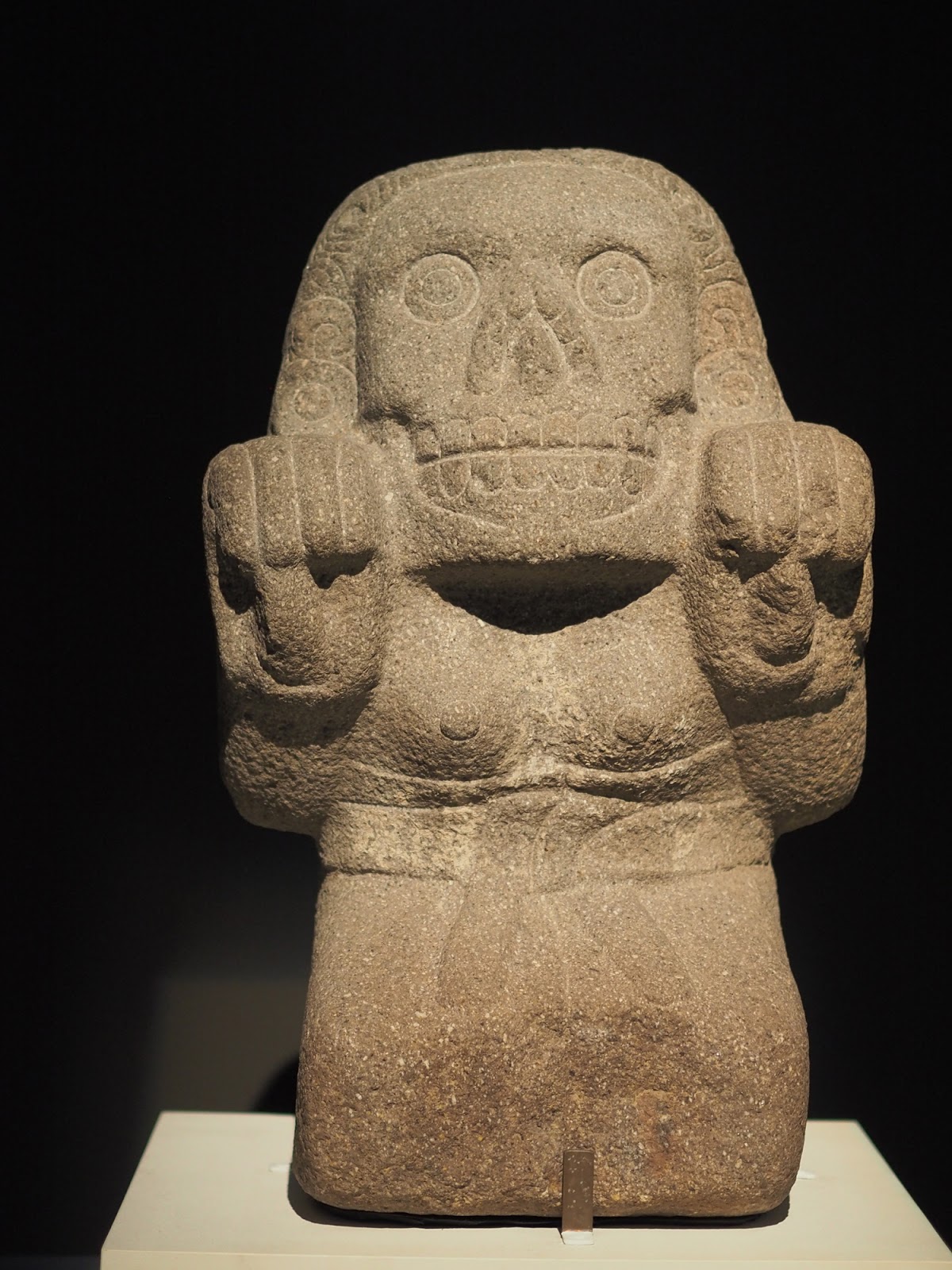
This is a statues of an Aztec spirit. Specifically that of a woman who died in childbirth. Whilst such women were honoured as highly as warriors, their restless spirits had to be placated to prevent them from causing harm in the material world.


The famous Lewis chessmen


Brasses from 16th century Benin, depicting European soldiers


This is a relatively modern artefact - an Afghan war-rug. Made in the 1980s, it shows Afghans fighting the occupying Russians, the latter being depicted as horned demons.


I cannot recommend this exhibition highly enough. I did see a few things written on some of the labels I had issue with (once again someone failed to understand just what Darwin's theory was about), but it was mostly excellently put together, with the context of each object briefly but clearly explained.

But be quick; it's only on until the end of January.


Aussie Bloggers Meetup - CanCon 2017

In 2016, this happened:


And in 2017 it's going to happen again:


The details  are as follows (courtesy of The Man Cave):

1:00pm - Initial meet-up in the Board Games section in the Northern Hall at CANCON to say g'day, check out respective loot bags and plan for any shared afternoon shenanigans.

6:00pm(ish) - Pub dinner and extended tall story session.

This year I'm planning on not having a migraine.

See you there?

Tuesday, 13 December 2016

Third Time Lucky?

Deep in my pile of 15mm HOTT armies I found my Peter Pig Arab boxed army. this seemed to be a perfect historical opponent for Prester John, so out it came and away we went.

Prester John defended, and with the enemy army having an aerial element went for a couple of woods to limit them. All of the bad going ended up on one half of the board, leaving the battle to be fought mostly on the other.

The Arabs massed their cavalry on their right, and went for a slow infantry advance in the centre. Poor PIPs meant that they couldn't bring the flying carpets up in support at first.


The Arab cavalry advanced unsupported towards Prester John's archers


And in they went. One element of archers fell, and some of Prester John's knights were actually forced back. But the line held.


The elephant and the other knights turned in support. Now the lack of supporting troops on the Arab side began to tell.


Meanwhile on the other flank Prester John's natives rushed out of the woods and turned on the Arab left, destroying the hordes there.


The flying carpets finally came up to support the rapidly diminishing Arab cavalry.


But they were too late. The cavalry was gradually destroyed, and the carpets pushed back by the elephant, all the way to the Arab infantry line, which had failed to advance quickly enough to support its horse.


The natives now destroyed some Arab archers, and the army broke.


The position at the end.


Prester John's victory was really won by the Arabs attacking with unsupported Riders against troops which could hold them. Had the Riders been properly supported they could have scored a breakthrough and put the stronghold at risk.

Monday, 12 December 2016

Prester John vs Sundiata


I plated another game of HOTT tonight, pitting Prester John against temporal and continental contemporary, Sundiata, the Lion King of Mali. The two armies are very similar in some areas - the same number of Knights and Shooters, Spears vs Blades, both with a Cleric - but different enough in others to keep things interesting, with Prester John's Behemoth and Warband opposed by Mali's Hero general and Riders.

Prester John defended, and closed down the battlefield a little with woods and a field in order to limit Sundiata's cavalry superiority. Sundiata led his Riders in an attack on Prester John's right.


The bulk of Sundiata's army. The Knights were in reserve.


A rapid advance from Sundiata.


On the other flank, Prester John sent the Warband to keep the Malians busy; with their general way out on the other flank, any response would be sluggish at best. The warriors killed Sundiata's bard Bala Fasseke.


Sundiata led a fierce attack on Prester John's infantry, sweeping away his archers in the first round of combat before they could even fire off a volley.


An aerial view of the battle. Sundiata sent his Knights to drive off the enemy Warband. Meanwhile Prester John was swinging his Knights around to hit Sundiata and his Riders in the flank.


Prester John's Knights lined up for the charge, but one element was cut down by Sundiata's archers, who had rushed forward in support.


The elephant joined in, and things actually started to look a bit sticky for Sundiata as he was slowly backed towards the edge of the battlefield and gamey oblivion.


His Knights, however, easily rode down Prester John's Warbands. This now left Prester John's army one element from defeat.


And it was the archers who clinched the final victory, forcing a Blade to recoil when it couldn't, thus destroying it.


The position at the end.


Prester John lost two Shooters, two Warband, a Knight and a Blade. Sundiata lost his Cleric and a Rider.


The game was closer than it looked, with Sundiata's bold flanking move, whilst being initially successful, nearly coming unstuck in the face of a counter-attack. His inability to effectively command his other flank - a hill and a wood reduced his command range - nearly cost him troops there as well. But enough PIPs to get his Knights into action, and some lucky kills by his archers were the keys to his victory.

Related Posts Plugin for WordPress, Blogger...