Saturday, 28 June 2025

A Simple English Civil War Campaign

The Dominion series of rules really come into their own if used as part of a campaign since they provide very quick battle resolutions whilst still giving an interesting game. So since I've got hold of Dominion Of Pike & Shot I've been pondering how to do a simple campaign for the ECW. The other day I sketched out a framework, which I've tested out over the past few days and got to a point I was happy to try for real.

I played through a full campaign this morning. It took about three hours, which I reckon is pretty good. I'll save the report for another post, but in this post I'll share the setup and mechanisms.

Originally I was going to use the map from Peter at Grid Based Wargaming's campaign from a couple of years ago, but I decided I wanted one that was simpler. To be honest I'm thinking that, now I've refined the mechanisms, his map would work OK as well, with a few adjustments to the timings of the campaign. But I'll leave that exercise for another day.

The campaign mechanisms are inspired by some used by Peter in the campaign linked above, and also IanH's Skodbac system, which readers of this blog will know I've used for HOTT campaigns a couple of times.

Here's what I came up with.

I drew up the following map. It's not as pretty as Peter's but is functional and I can colour it in properly another day.

As you can see it's split into nine regions. Two of them contain Capitals. Parliament's capital is London (in the South -East region) whilst the Royalist capital is Oxford in the Midlands region. Both sides start in control of two regions:

Royalists: Midlands, South-West
Parliament: South-East, East Anglia

All of the other regions are uncontrolled at the start of the campaign.

The campaign runs from 1642 to 1646, and two battles will be fought each year.

A side wins the campaign if:

(i) The opposing side controls no regions.
(ii) A side controls the region containing the opposing capital and also controls at least four more regions than the other side does.
(iii) At the end of 1646 the side that controls the most regions wins. 

How do you play the campaign?

The 1642 year is played out differently to the other years. Randomly determine two of the uncontrolled regions. For each one fight a battle. The side that wins the battle gains control of the region.

At the start of 1643 each side will therefore control 2-4 regions.

From 1643 proceed as follows:

Play at least two phases in each year.
In each phase roll a D6 for each controlled region that is either adjacent to an enemy-controlled region or is adjacent to an uncontrolled region. Some areas may be adjacent to both.
Add 1 to the roll for each enemy-controlled region.
Subtract 1 from the roll if  in the previous phase an attack was made from that region which failed to capture the enemy region or if the region was captured via a battle in the previous phase.
A score of greater than 6 are treated as 6. A score of less than 1 is treated as 1.

The region with the highest score is the active region for that phase. If two or more regions have the same high-score then randomly determine which one is active.

The active region will attack an adjacent region.
If you attack an adjacent uncontrolled region then simply place a marker on it to show control. No battle is fought.
If you attack an enemy-controlled region then a battle is fought.

(If playing solo, then roll additional D6 for each uncontrolled region adjacent to the active region. Controlled regions keep the score they rolled when determining the active region. The active region will attack the adjacent region with the lowest score. If two or more regions are tied for lowest score then the active region will attack uncontrolled regions in preference to enemy-controlled ones.)

If a battle takes place then it is fought using Dominion of Pike & Shot. Determine the armies according to the random Army generator HERE. Note that the random lists assume that you are using my modified rule for mixed pike & shot units.

To determine attacker and defender both sides roll a D6 and add their total number of mounted units. The side with the highest score is treated as the attacker in the battle. This may not be the side that is attacking the region.

If the side that controls the region wins then they retain control. The active region will get a -1 on the next roll to determine active region (see above)

If the side controlling the active region wins then they capture the region. This region will get a -1 on the next roll to determine active region (see above)

When two battles have taken place the year ends.

At the end of 1646, determine who has won. 

In my next post I will post a report of the campaign so you can see how it works.

Friday, 27 June 2025

Thursday HOTT - Double Sized!

We played HOTT again last night, but this time it was a single 48AP game.

To be fair, as usually happens with such thing, it turned into two 24AP games, but we played until the combined armies had lost half of their AP (and ignored victory through killing the opposing CinC in the interests of keeping the game going).

We assembled two armies for each side using Geoff and Peter's Late Medieval/Early Renaissance troops, and added in clerics, heroes and even a paladin as required. I'm not sire what everyone else had but I went for two knights, four spears, four shooters and a behemoth general.

Here we are, ready to go. I was teamed with Geoff, whilst Peter and Dave were on the other side of the small table. 48AP HOTT with for players is a very cosy game.


Here's my army. The red turtle-car is my behemoth general. The long Leonardo Da Vinci horse-drawn scythes are the knights. 


This is Geoff's command. There's a cleric and some artillery in there, and also a paladin.


Anyway, as always happens with these things I lost track of what was happening on the other side of the board, and left Geoff to fight Dave, whilst I concentrated on defeating Peter. This wasn't helped by my general being forced to flee by Peter's artillery.


Here's a nice shot of the scythe-knights. The long bases proved awkward to use and created some issues with a flanking move later on in the game. But otherwise they were magnificent.


Dave and Geoff got stuck in fairly quickly.


A view down the line. Peter's troops had hung back to make use of a wood on their flank. His knights filled the gap between his army and Dave's and I sent my behemoth general towards it.


The scythed chariots mowed through some enemy spears.


And my general ploughed through the knights.


Taking out Peter's knight general required the assistance of Geoff's paladin, who then wheeled around and destroyed the artillery that had been annoying me. However by this stage Geoff's forces were collapsing and without w general, so we needed to kill more stuff.


We didn't manage it. Peter and Dave destroyed half of our AP. Although I think Geoff and I had dropped the margin to 2-4AP by the end, so it was close.


Thursday, 26 June 2025

Dominion Of Marlborough And Peter The Great

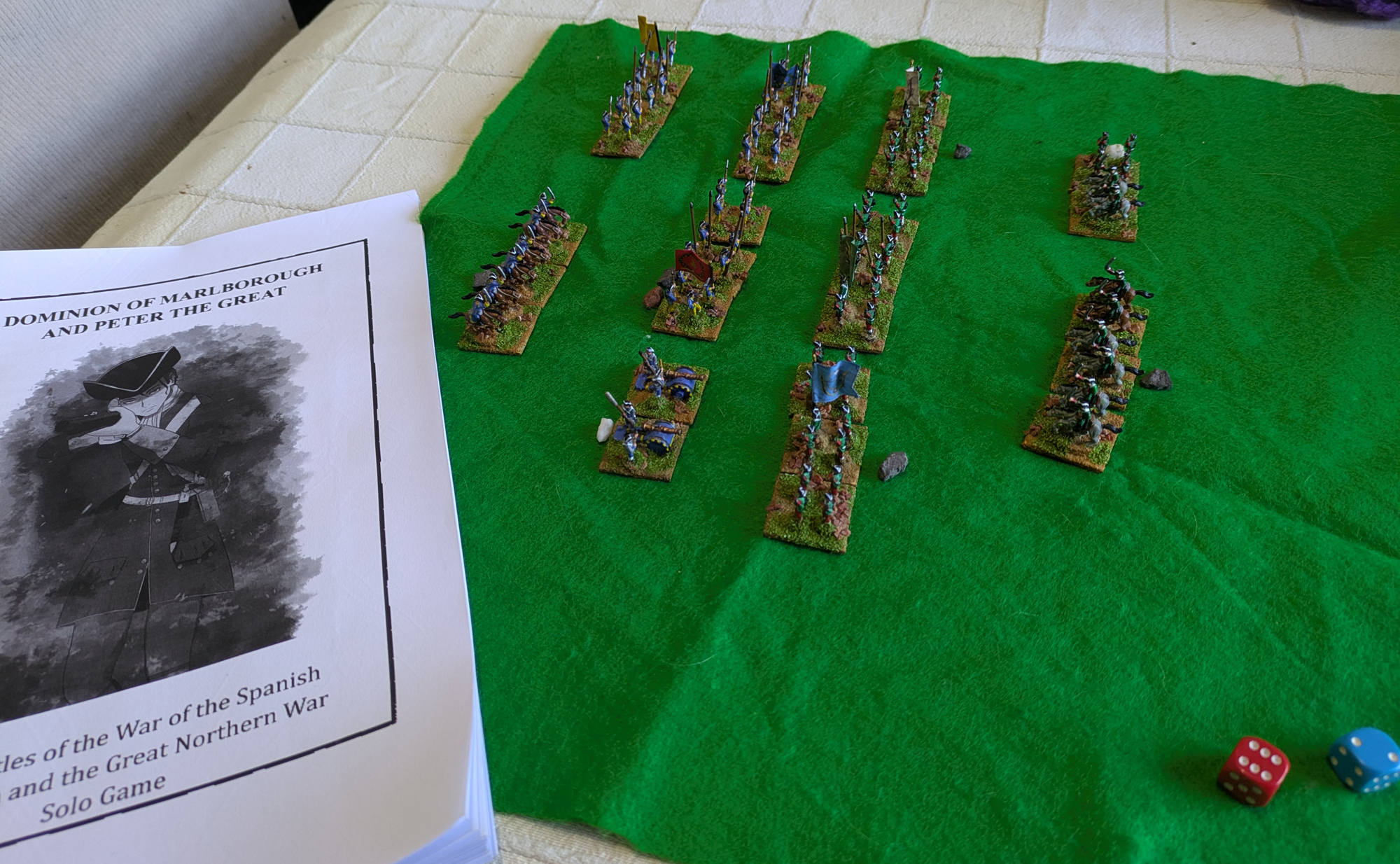
I bought another of the Dominion series yesterday. 'Dominion Of Marlborough And Peter The Great' covers the War Of Spanish Succession and Great Northern War (as you'd expect). It's the same format as the other Dominion games, offering five minute battles with 4-6 units on each side. Like the other more recent books it has the rules and then, in lieu of formal army lists, it has setups for some 24 battles of the period, from Sedgemoor in 1685 to Sherrifmuir in 1715. So a pretty short time period.

Troop types are pretty much what you'd expect from other rules in the series, but there is the inclusion of Ga Pa Infantry for the Swedes, who sit between the volley-firing Line Infantry and the various pure melee types.

The rules continue to use the idea of a combat being rolled in sequence based on the troop types, and period flavour is built in by a series of modifiers, with certain units getting bonuses against other types. In addition it includes a rule that foot that start in an army's front line are more resistant to cavalry charges as they are considered 'in position'.

A lot of the scenarios make use of Unreliable troops to reflect such things as flank-marchers who may or may not turn up. I like this idea. A lot of front-line artillery is unreliable; it may get in a bombardment or may simply have no effect on the battle.


Anyway I had a few minutes at lunchtime and set up a couple of the Great Northern War scenarios.

The first was Holoczyn, fought in 1708 in which the Swedes forced a river-crossing against entrenched Russian troops and drove them off. I used stones to mark the various traits; elite, disciplined/entrenched or unreliable.

In my refight the Swedes swept to an fairly easy victory, smashing the Russian centre.


I then tried the 1709 Battle of Poltava. This makes a lot of use of unreliable troops to bulk out the Russian army, making it larger than the measly four units the Swedes get. The entire Russian front-line is unreliable to reflect the redoubts; the Swedes may just pass through them with little disruption (as was the plan) or may get bogged down.

In my refight they got seriously bogged down as the redoubts put up an epic defence. The Swedes had little success anywhere and were swiftly and ignominiously defeated.

As with the other sets in the series they aren't necessarily a set of rules for stand-alone games, but will do for a campaign of some kind.

And on that note I should point out that I had a very profitable session yesterday where I worked out the framework of a simple ECW campaign designed for use with Dominion Of Pike & Shot. If I get chance I'll run it through this weekend.

Friday, 20 June 2025

Denmark And The Desert

I'm still on my Memoir '44 kick at the moment. Last night I organsied a game with Stuart, but June was also available and was interested in playing too. So I stepped aside and tutored the two of them since neither had played it before.

As a starting game I went for the Roadblock At Hokkerup scenario. This represents a fairly small-scale action during the German invasion of Denmark in 1940. Germans have to break through a defended Danish roadblock and get points for exiting nits off the Danish board edge as well as eliminating enemy units.  It's mostly infantry, but the Germans do get their special Blitzkrieg rules which make them strong in air support.


In the first game June took the Danes. It looked like a quick win for Stuart was on the cards when he overwhelmed the Danish left and had a clear run to the exit point with enough units to get a win.


But his good cards ran out after exiting a couple of units, and a Danish counterattack pushed back the outflanking moves.

When June's turn came to play the Germans in the second game she got a good draw of cards in the centre and was able to launch a massive assault on the Danish position. Air attacks forced the Danes out of their defences.


I'm sorry to say that in all the excitement I forgot which side won each game, but I seem to recall that when the scores were aggregated the margin was only one victory medal; both games were very close, I remember that.

We then switched theatres and set up the November 1941 battle at Sidi Rezegh Airfield, which sees an all armoured British force trying to take the eponymous airfield being ambushed by German panzers.

It has a lot of tanks.


Again June and Stuart played both sides. In the first June's British were pinned against their baseline  by an aggressive German assault and suffered a lot of casualties. In the second game Stuart was able to push the British forward and attack the airfield.


Once again I forget who won what in terms of games. The margin of victory when the scores were aggregated was pretty close though. The game was good fun, with lots of swirling tank action, and the impassable escarpments causing some problems with retreats.

So a great evening, even if I didn't get to play. 

Thursday, 19 June 2025

Waterloo

It's been almost two weeks since I posted here!

I have been managing a small amount of gaming. It's mostly been Memoir '44 because, at the moment, I find I am enjoy playing a lot of Memoir '44. But otherwise a combination of family, illness and a slight promotion at work have contrived to keep me too busy to manage much else in the way of gaming.

However last night being the 210th anniversary of the Battle of Waterloo, Catherine and I had a couple of games of W1815. We each had a go at playing as Napoleon and Wellington, and I can report that I lost both games. 


In the first my Allies were bombarded by the Grand Battery and simply couldn't shift it. Attempts to relive Wellington with the Prussians were stymied by the energetic Lobau. Allied morale quickly collapsed and the French scored an easy win.

In the second game an energetic French attack scored plenty of successes, but at the cost of considerable casualties. With the Allied morale looking wobbly I took a gamble of ignoring the Prussians and went for one last push against the Allied line instead. It didn't work and the Prussians capturing Plancenoit put paid to the French army.

Related Posts Plugin for WordPress, Blogger...