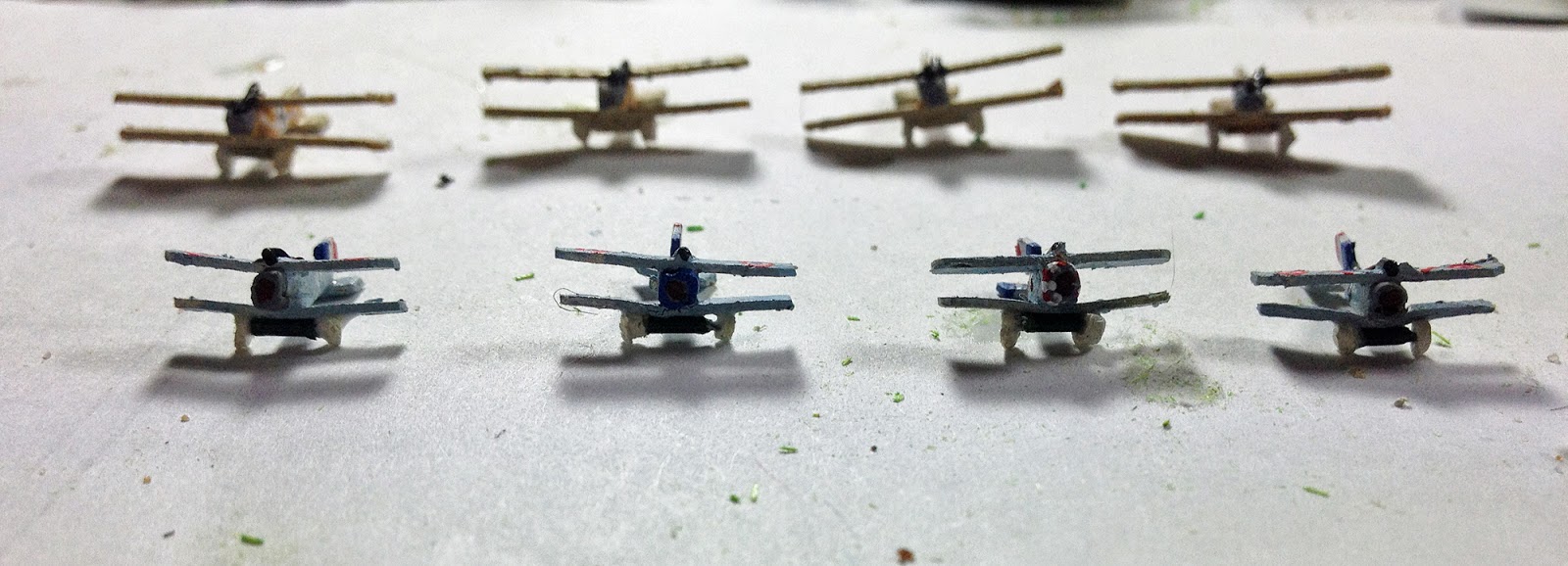
I painted the Nieuports this morning. It says something for their fragility that, to some extent, it's the paint that's holding them together (I actually mix a little PVA into the undercoat, just to help seal everything).
Still, they look good enough. I just have the undercarriages to make for both sets of aircraft, then I can varnish them and mount them on flying stands ready for their first outing.
Update: I made the wheels (Milliput) and attached them. Just need to paint them now, once the Milliput and glue are dry.
Sunday, 20 April 2014
Saturday, 19 April 2014
More Micro Planes
I have been making some more 1/600th WW1 aircraft in the last week or so. This is driven by the fact that, whilst Tumbling Dice do a nice selection of late-war 1/600th planes, they do nothing earlier than about 1917. And no-one else makes 1/600th WW1 planes (one company looks like they're working on it, and has produced a Spad XII, but one Spad does not a range make).
So if there's anything I want or need, I have to make my own.
I scratchbuilt a few last year - DH2s, Fokker EIIIs, BE2s and some BE2s which didn't come out right but ended up the right size and shape to be Martinsyde G100s. I decided that for this batch I needed an earlier German two-seater than the ones I currently have, and something French. So I am working on some Albatros CIIIs and Nieuport 17s.
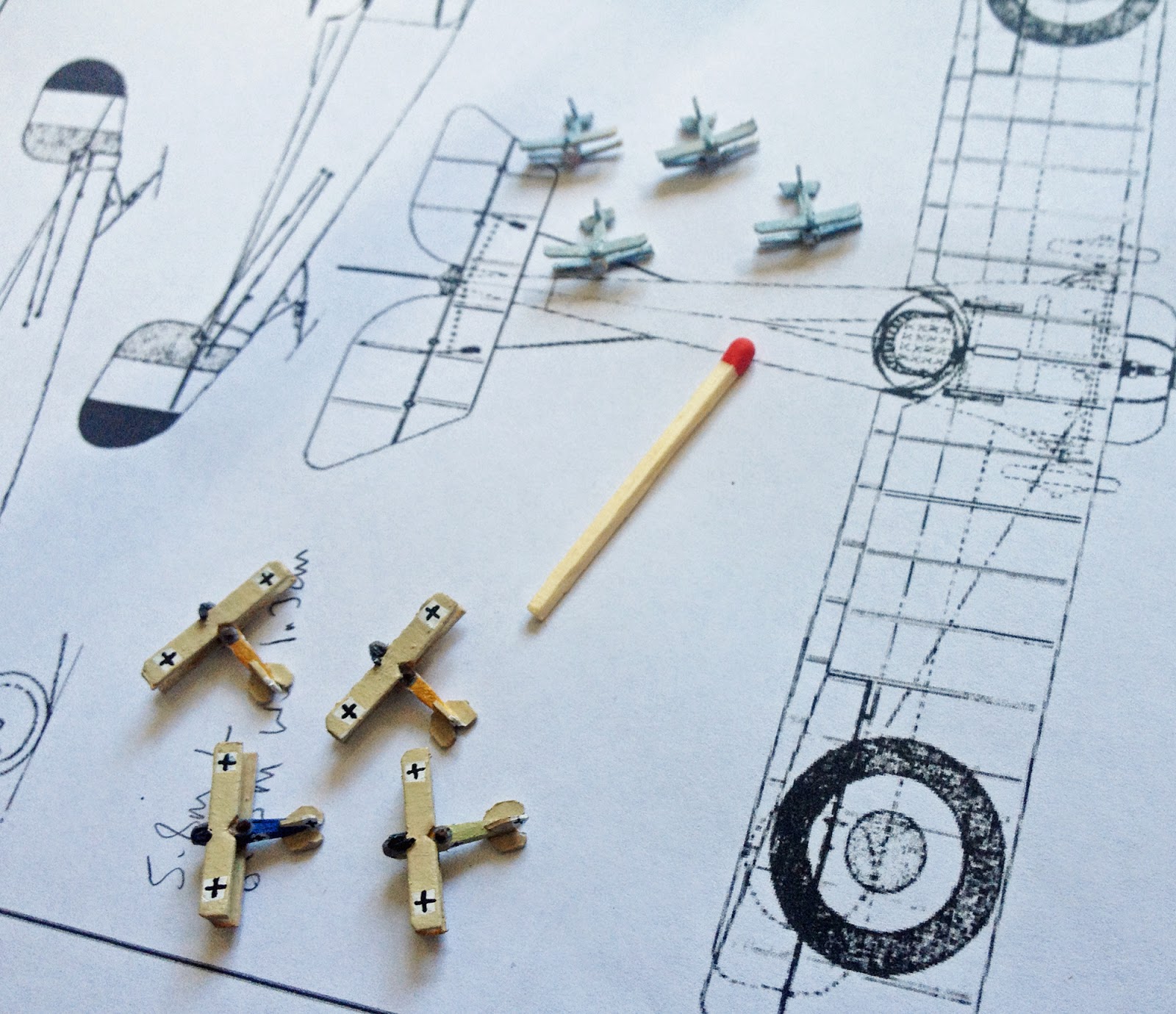
Here they are, with a matchstick for scale. I use matchsticks for the fuselage:
The Albatri are almost completed - I just need to do the undercarriages on them (which involves making a batch of wheels). The Nieuports are at the initial painting stage, but I may have to rebuild parts of them, as they're very fragile and I'm not sure how they'll stand up to handling in a game environment.
Here's the Albatri a week or so ago, when I'd just started painting them:
And a closeup of the Nieuports. They're about a centimetre in length.
So if there's anything I want or need, I have to make my own.
I scratchbuilt a few last year - DH2s, Fokker EIIIs, BE2s and some BE2s which didn't come out right but ended up the right size and shape to be Martinsyde G100s. I decided that for this batch I needed an earlier German two-seater than the ones I currently have, and something French. So I am working on some Albatros CIIIs and Nieuport 17s.
Here they are, with a matchstick for scale. I use matchsticks for the fuselage:
The Albatri are almost completed - I just need to do the undercarriages on them (which involves making a batch of wheels). The Nieuports are at the initial painting stage, but I may have to rebuild parts of them, as they're very fragile and I'm not sure how they'll stand up to handling in a game environment.
Here's the Albatri a week or so ago, when I'd just started painting them:
And a closeup of the Nieuports. They're about a centimetre in length.
Friday, 18 April 2014
The Battle of Oudenarde
After Blenheim and Ramillies, this was the latest in Caesar's Marlborough scenarios for 'Maurice'. We played it as a doubles game, with Ralph and I being the experienced players on each side, and Austin and Dave learning as they went on.
Oudernarde was a French attack on an Allied bridgehead over the River Scheldt. Being the Low Countries, the battlefield was very damp.
Austin and I played those jolly allies, Marlborough and Eugene. We had a small force covering the town of Oudernarde (the French objective), and the promise of reinforcements to come.
Ralph and Dave played the French - Ralph the rash French C-in-C (whose name eludes me), and Dave the tardy Duke of Burgundy. What could possibly go wrong?
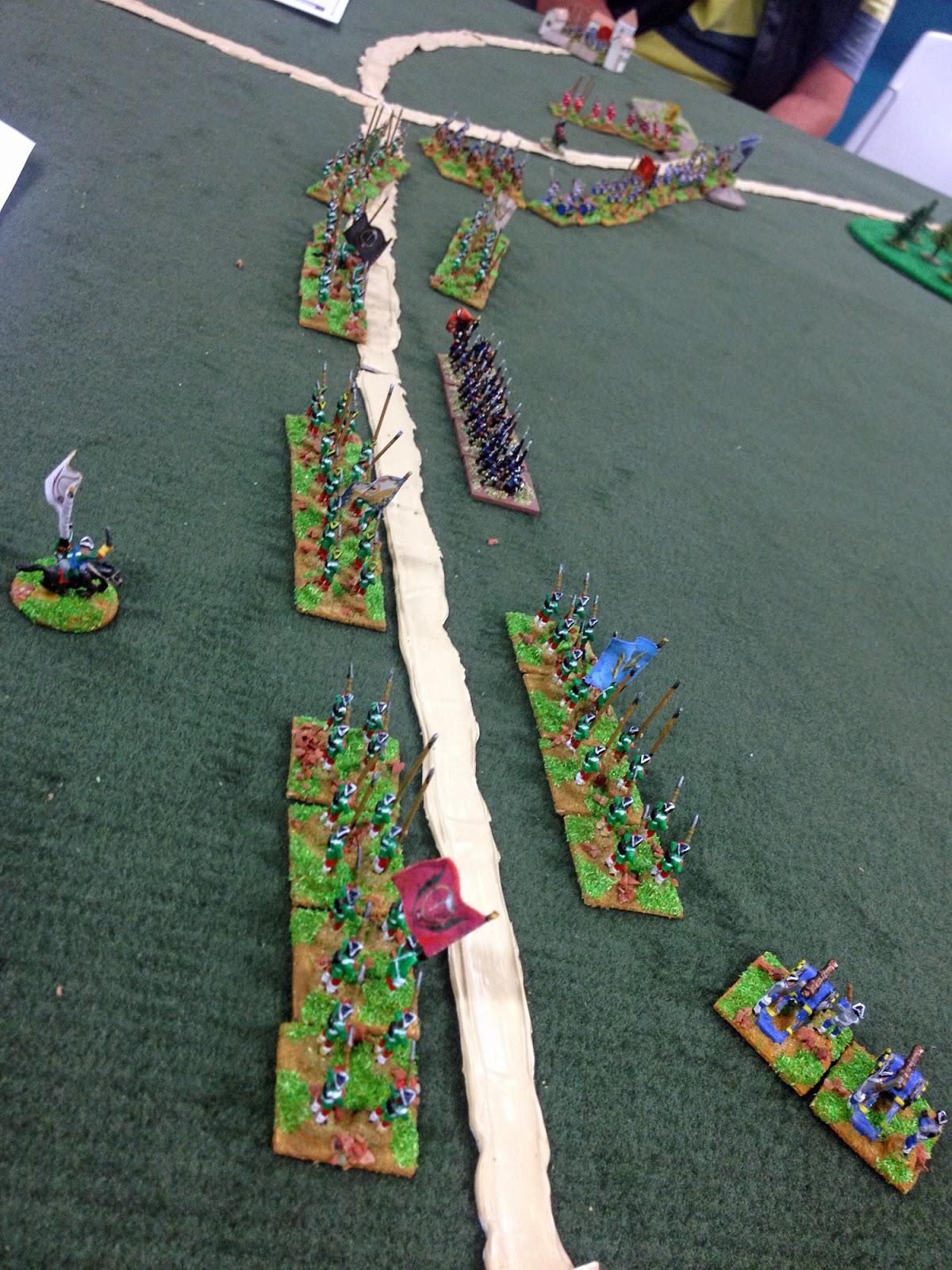
Here's a view down the French lines. Once again we used whatever figures we could muster, so our armies were made up of a mix of Caesar's Imagi-Nations ("Why are my troops marching under a flag with a teapot on it?") and my GNW Russians and Swedes, in their Painted, Based and Varnished debut game.
The French had lots of infantry. There was also the promise of reinforcements coming in on our right flank.
The heroic Allied infantry; stout chaps who eschew the consumption of garlic and frog appendages. Many of them seemed to be wearing borrowed Russian uniforms. Apart from the ones who looked like Swedes. And a lone elite unit who had come to the party as Prussians.
Anyway, we formed up in a double line and awaited the inevitable French advance.
Dave also had a shed-load of infantry, the photo of which was so blurry that I won't bore you with it. Since it, and the promised French reinforcements, threatened our right flank, I garrisoned the village that covered that end of our line. This had nothing to do with me wanting to try out my new buildings.
The other end of our line, with the French infantry beyond it. Ralph is, at heart, a Frenchman from a century later than this period, so formed them into column and prepared to attack. He had the bayonets advantage, so it wasn't a bad plan on paper.
The French attacked, although some confusion about changing formation in this more stately era left them trying to form up into line in range of the rather effective Allied musketry. Our plan was rather simple - let the French get partially across the river (which they did without disruption thanks to a well-timed card), then move in close and blow them away with gunfire whilst leaving them no room to maneuver.
It worked quite well.
Once our infantry were nicely ensconced in a firefight, I switched Eugene to our other flank where my cavalry were lurking. The Duke of Burgundy, under Dave, was advancing his infantry to support Ralph, covered by his Guard cavalry. I moved up my gallant cavaliers to oppose his (who apparently regard horses as not only the best way of engaging in warfare, but as part of their national cuisine as well). With his attention focused on the cavalry battle, the Duke of Burgundy stopped advancing his infantry, buying ours a bit more time.
Guard cavalry are a tough nut to crack. It took a few useful melee cards to hold them off, and we still lost one of our cavalry units.
Back at the main fight, Ralph was losing infantry units to our Lethal Volleys, but stuck to his plan of charging, charging and charging again. We responded with every melee bonus card we could slap down on the table; a number of our units held off potentially deadly attacks only by virtue of a card-given bonus. And, of course, every time a French attack faltered and pulled back we blasted it with musketry. The French morale was now looking rather shaky.
The French Guard cavalry charged and swept away one of our - MY! - cavalry units. The dogs!
"You have a flank attack there", said utterly neutral umpire Caesar (born in England). So we charged it. Au revoir, French Guard cavalry.
This put the French down to one point of morale. "Don't worry," said Ralph, "There's a card we can play to increase our army morale!". "We know," we said, "We've got it."
Here's the Duke of Burgundy, pictured just before a stray cannonball took off his head. Austin had been hoarding the 'Death of a Hero' card for most of the game, and played it. Away went the last vestige of the French will to fight, and Marlborough/Eugene had won themselves another famous victory, plus piles of cash from their respective grateful sovereigns.
The French slunk away, secure at least in the knowledge that their cavalry losses, combined with the amphibian-laden marshes through which they were retreating, meant that they wouldn't be going hungry any time soon.
Truth be told this was a difficult mission for the French, with the two parts of their army separated, whilst being on the offensive. Apparently it went pretty much according to history, with the one wing attacking aggressively whilst the other dithered. We suspect that the French need to bide their time in the early part of the game, and get all their troops together first. The downside of this is that it gives them less time to mount the attack before the decks run out, and that it gives time for the Allied reinforcements to appear. Of course the French have reinforcements too, but with hindsight I suspect they appear too far from where the main battle is fought to be of any great use.
The Allies are in a strong position, with villages to fortify and an impassable river to cover one flank. We were able to concentrate the battle into a limited area, where the French numbers didn't count for much and where our superior firepower gave us the edge. And, with any game of 'Maurice', switching the focus of the battle at a key moment paid dividends; a handful of 'Co-ordinated' cards helped there.
Thanks to Caesar for organising a great scenario, to Austin for falling in with my cunning plan, and to Ralph and Dave for being gallant opponents, even if they were French.
The game took us just under three hours to play (excluding setup), and we didn't finish the first deck.
Oudernarde was a French attack on an Allied bridgehead over the River Scheldt. Being the Low Countries, the battlefield was very damp.
Austin and I played those jolly allies, Marlborough and Eugene. We had a small force covering the town of Oudernarde (the French objective), and the promise of reinforcements to come.
Ralph and Dave played the French - Ralph the rash French C-in-C (whose name eludes me), and Dave the tardy Duke of Burgundy. What could possibly go wrong?
Here's a view down the French lines. Once again we used whatever figures we could muster, so our armies were made up of a mix of Caesar's Imagi-Nations ("Why are my troops marching under a flag with a teapot on it?") and my GNW Russians and Swedes, in their Painted, Based and Varnished debut game.
The French had lots of infantry. There was also the promise of reinforcements coming in on our right flank.
The heroic Allied infantry; stout chaps who eschew the consumption of garlic and frog appendages. Many of them seemed to be wearing borrowed Russian uniforms. Apart from the ones who looked like Swedes. And a lone elite unit who had come to the party as Prussians.
Anyway, we formed up in a double line and awaited the inevitable French advance.
Dave also had a shed-load of infantry, the photo of which was so blurry that I won't bore you with it. Since it, and the promised French reinforcements, threatened our right flank, I garrisoned the village that covered that end of our line. This had nothing to do with me wanting to try out my new buildings.
The other end of our line, with the French infantry beyond it. Ralph is, at heart, a Frenchman from a century later than this period, so formed them into column and prepared to attack. He had the bayonets advantage, so it wasn't a bad plan on paper.
The French attacked, although some confusion about changing formation in this more stately era left them trying to form up into line in range of the rather effective Allied musketry. Our plan was rather simple - let the French get partially across the river (which they did without disruption thanks to a well-timed card), then move in close and blow them away with gunfire whilst leaving them no room to maneuver.
It worked quite well.
Once our infantry were nicely ensconced in a firefight, I switched Eugene to our other flank where my cavalry were lurking. The Duke of Burgundy, under Dave, was advancing his infantry to support Ralph, covered by his Guard cavalry. I moved up my gallant cavaliers to oppose his (who apparently regard horses as not only the best way of engaging in warfare, but as part of their national cuisine as well). With his attention focused on the cavalry battle, the Duke of Burgundy stopped advancing his infantry, buying ours a bit more time.
Guard cavalry are a tough nut to crack. It took a few useful melee cards to hold them off, and we still lost one of our cavalry units.
Back at the main fight, Ralph was losing infantry units to our Lethal Volleys, but stuck to his plan of charging, charging and charging again. We responded with every melee bonus card we could slap down on the table; a number of our units held off potentially deadly attacks only by virtue of a card-given bonus. And, of course, every time a French attack faltered and pulled back we blasted it with musketry. The French morale was now looking rather shaky.
The French Guard cavalry charged and swept away one of our - MY! - cavalry units. The dogs!
"You have a flank attack there", said utterly neutral umpire Caesar (born in England). So we charged it. Au revoir, French Guard cavalry.
This put the French down to one point of morale. "Don't worry," said Ralph, "There's a card we can play to increase our army morale!". "We know," we said, "We've got it."
Here's the Duke of Burgundy, pictured just before a stray cannonball took off his head. Austin had been hoarding the 'Death of a Hero' card for most of the game, and played it. Away went the last vestige of the French will to fight, and Marlborough/Eugene had won themselves another famous victory, plus piles of cash from their respective grateful sovereigns.
The French slunk away, secure at least in the knowledge that their cavalry losses, combined with the amphibian-laden marshes through which they were retreating, meant that they wouldn't be going hungry any time soon.
Truth be told this was a difficult mission for the French, with the two parts of their army separated, whilst being on the offensive. Apparently it went pretty much according to history, with the one wing attacking aggressively whilst the other dithered. We suspect that the French need to bide their time in the early part of the game, and get all their troops together first. The downside of this is that it gives them less time to mount the attack before the decks run out, and that it gives time for the Allied reinforcements to appear. Of course the French have reinforcements too, but with hindsight I suspect they appear too far from where the main battle is fought to be of any great use.
The Allies are in a strong position, with villages to fortify and an impassable river to cover one flank. We were able to concentrate the battle into a limited area, where the French numbers didn't count for much and where our superior firepower gave us the edge. And, with any game of 'Maurice', switching the focus of the battle at a key moment paid dividends; a handful of 'Co-ordinated' cards helped there.
Thanks to Caesar for organising a great scenario, to Austin for falling in with my cunning plan, and to Ralph and Dave for being gallant opponents, even if they were French.
The game took us just under three hours to play (excluding setup), and we didn't finish the first deck.
Tuesday, 15 April 2014
Tinkering With Spandau And Lewis
In odd moments I have been playing small, quick, games of 'Spandau and Lewis', in order to try out possible changes. Most of these I have written about over the last couple of weeks, but I'm slowly settling on some alterations that I think I can live with.
Firstly, I have tried increasing the number of hits an aircraft can take. This increases their survivability and offsets the ease of lining up shots that my generous, but easy to adjudicate, firing ars offer. Aircraft are generally shot down by critical hits now - the pilot being killed, or an engine hit. I'm still playing with the numbers, but I have increased a 5 hit plane to 8 and a 6 hit plane to 10.
In concert with the above I have reduced the number of shots an aircraft has. Each gun now only has 8 bursts. This equates, on average and very roughly, to about 16 dice over the course of the game, so with a 1 in 3 or 1 in 2 chance of each gun scoring a hit you can see that you have to be very lucky to bring down a plane by shooting it to pieces. You can hinder its performance by scoring half damage on it, though*.
Finally I am settling on a way of representing loss of speed and agility through sustained maneuver, and the ability to recover via power. It does require an on-table marker, though, something I've always been keen to avoid.
As with previous incarnations of this rule, a plane has a Power rating of between 0 and 4. Generally early planes and two-seaters will tend towards the lower end of this score, whilst scouts and later planes will be at the upper end.
If a plane turns more than 45 degrees or sideslips more than 1" - an Extreme Maneuver - then it must roll under its Power on a D6 or pick up a marker. If a plane begins its Maneuver Phase with a marker then it cannot declare a speed greater than half its maximum (rounded up). It can still maneuver, but generally will do so at a penalty (there's a -1 if your declared speed is 3 or less, don't forget). If it turns 45 degrees or less, or sideslips 1" or doesn't maneuver at all, then the marker is removed. If it does another Extreme Maneuver then the marker stays on; there is no roll to remove it. In other words, once a plane acquires a marker, only limiting your maneuver (voluntarily or otherwise) will allow you to remove it and move at greater than half-speed on your next turn.
Testing continues ...
*And if it sounds difficult to shoot down enemy planes, consider one test game which saw four Sopwith Camels take on three Fokker DVIIs and a Triplane. Three Camels were shot down for no German loss - one with its pilot killed (an Ace as well), one through an engine fire and one via progressive damage after being tailed for several turns. Most hits were scored by a single DVII (also an Ace) with some help from the Triplane.
Firstly, I have tried increasing the number of hits an aircraft can take. This increases their survivability and offsets the ease of lining up shots that my generous, but easy to adjudicate, firing ars offer. Aircraft are generally shot down by critical hits now - the pilot being killed, or an engine hit. I'm still playing with the numbers, but I have increased a 5 hit plane to 8 and a 6 hit plane to 10.
In concert with the above I have reduced the number of shots an aircraft has. Each gun now only has 8 bursts. This equates, on average and very roughly, to about 16 dice over the course of the game, so with a 1 in 3 or 1 in 2 chance of each gun scoring a hit you can see that you have to be very lucky to bring down a plane by shooting it to pieces. You can hinder its performance by scoring half damage on it, though*.
Finally I am settling on a way of representing loss of speed and agility through sustained maneuver, and the ability to recover via power. It does require an on-table marker, though, something I've always been keen to avoid.
As with previous incarnations of this rule, a plane has a Power rating of between 0 and 4. Generally early planes and two-seaters will tend towards the lower end of this score, whilst scouts and later planes will be at the upper end.
If a plane turns more than 45 degrees or sideslips more than 1" - an Extreme Maneuver - then it must roll under its Power on a D6 or pick up a marker. If a plane begins its Maneuver Phase with a marker then it cannot declare a speed greater than half its maximum (rounded up). It can still maneuver, but generally will do so at a penalty (there's a -1 if your declared speed is 3 or less, don't forget). If it turns 45 degrees or less, or sideslips 1" or doesn't maneuver at all, then the marker is removed. If it does another Extreme Maneuver then the marker stays on; there is no roll to remove it. In other words, once a plane acquires a marker, only limiting your maneuver (voluntarily or otherwise) will allow you to remove it and move at greater than half-speed on your next turn.
Testing continues ...
*And if it sounds difficult to shoot down enemy planes, consider one test game which saw four Sopwith Camels take on three Fokker DVIIs and a Triplane. Three Camels were shot down for no German loss - one with its pilot killed (an Ace as well), one through an engine fire and one via progressive damage after being tailed for several turns. Most hits were scored by a single DVII (also an Ace) with some help from the Triplane.
Monday, 14 April 2014
The Land Of Counterpane
A blast from my past. The poem's by Robert Louis Stevenson, of course, but I found this rendition of it in a book called '366 Goodnight Stories', which I've had since about 1966. This makes it one of my earliest exposures to wargaming. I'd actually forgotten I'd got this book, despite it moving house with us several times over the last few years. I just assumed that it had long ago been given to charity shop after we all grew out of it. Obviously not.
Wargaming in bed sounds great, but it's obvious Stevenson didn't own cats.
My friend Richard uses it as the title of his BLOG.
Wargaming in bed sounds great, but it's obvious Stevenson didn't own cats.
My friend Richard uses it as the title of his BLOG.
Subscribe to:
Posts (Atom)