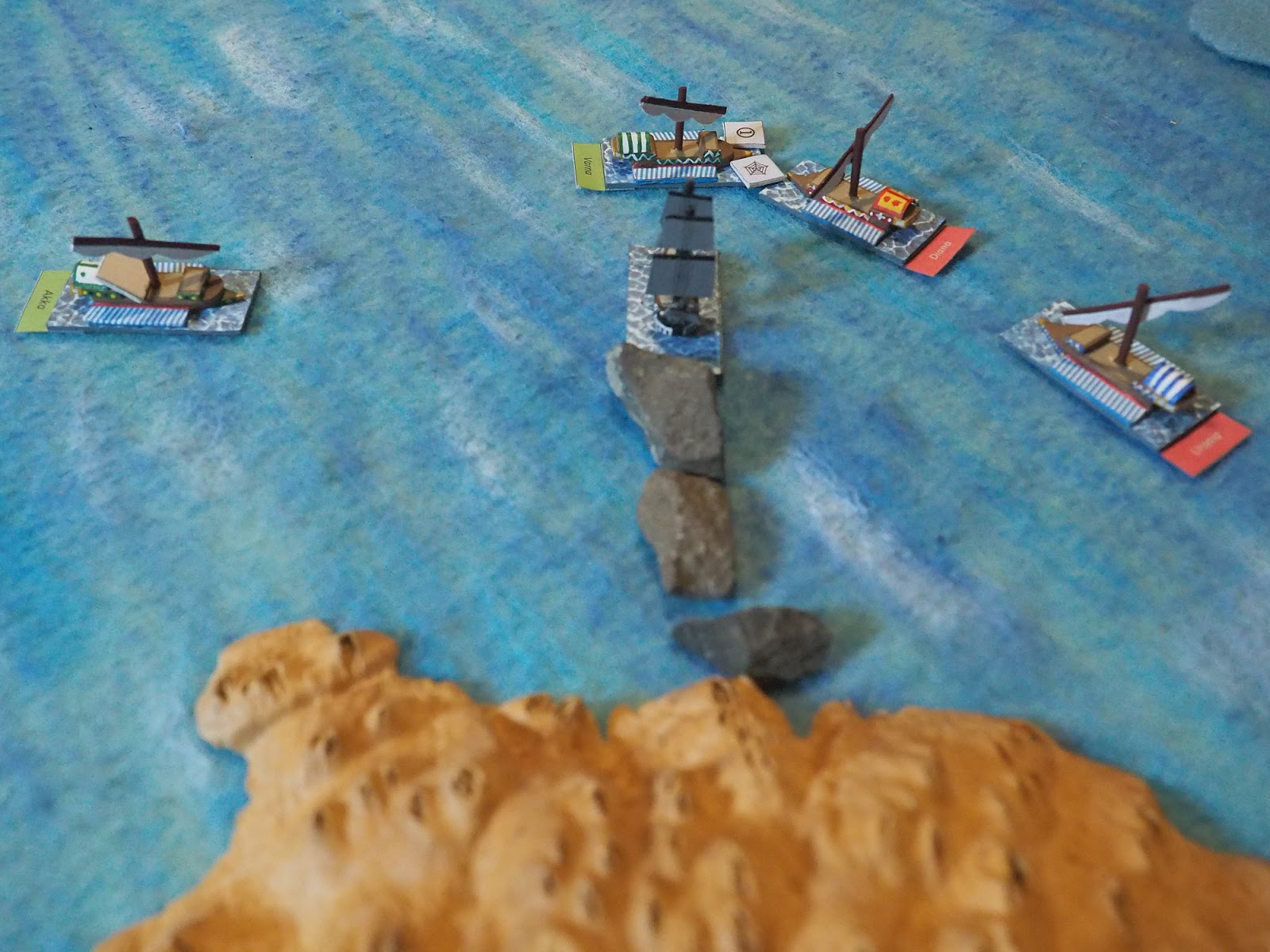
Having tried my Renaissance galleys on Thursday I decided to go all out today and get them all on the table along with the galleasses. I set up a straight head-to-head fight, Venetians vs Turks. I used ship-profiles straight from the book, except that I ran the galleasses as lateen-rigged because I wasn't paying attention when I copied over the information.
I set up the game across the table, with two headlands on each side, then some randomly positioned shallows, a small island and a sandbar. This was the setup after deployment and determination of wind direction.

The Venetians
(Left to Right, Front Line) - Diana (Galliot), Jacopo Guoro (Galleass), Urania (Galliot)
(Left to Right, Rear Line) - Tre Mani (Galley), Andrea De Cesare (Galleass), Due Leone (Galley + Flagship)
Their plan was to send the galleasses into the middle, between the shallows, then anchor and control the centre with their gunfire. The galliots were to cover the flanks and the galleys to move to counter the main Turkish attack.

The Turks
(Left to Right, Front Line) - Varna (Galliot), Akka (Galliot), Nur-ul-Bahir (Lanterna + Flagship), Ziver-i-Derya (Galley)
(Left to Right, Reserve Line) Sahir-i-Derya (Galley), Nasr-i-Huda (Lanterna)
The Turkish plan was to send the two lanternas and a galley around to the right, where there was more open water to manuever in and where they'd be upwind of the galleasses, whilst the galliots would fight a delaying action on the left. One galley would act as a reserve.

The position a few turns in. In the distance the Turkish galliots were making a wide sweeping move, whilst the main Turkish attack was developing towards the west. The Venetians had started badly, with some failed activations early on. The galleasses were moving slowly in the centre, the galley were heading west as well and the galliots were moving forward in support of the galleasses.

Opening shots! The Urania fired at the Akka, and killed the Turkish ship's captain.

To the west the Turks formed up in a line abreast, and the powerful lanternas opened fire, managing to inflict a hit on the Venetian flagship even at long range.


The galleass Jacopo Guoro joined the fight, firing at long range with its powerful bow-guns. The Diana was also coming up in support.

The Varna turned to fire on the galleass, and closed the range, but the Jacopo Guoro kept ploughing forward with the wind on its beam, and the ensuing collision saw the Varna badly damaged. The Urania fired in support, but was now badly damaged, with several banks of oars destroyed and its tiller shattered.

An overview of the battle. To the left the Turks were now firing steadily and it was obvious that the two Venetian galleys there were outnumbered and outclassed. They would have to bring the galleasses across in support, but this would be a slow process for the cumbersome vessels, which also needed to clear the shallows before making the turn.


However the galleasses have powerful broadsides, and even at range they were deadly. The Varna had backed off from the Jacopo Guoro, but a single broadside saw it smashed to smithereens and sunk.

Meanwhile the Andrea De Cesare fired its first broadside of the game, damaging the Turkish flag, the Nur-ul-Bahir.

To avoid an encirclement, however slow, by the galleasses, the Turks pressed forward onto the stricken Venetian galleys. The Ziver-i-Derya closed on the Tre Mani, and boarded. In a short action the already damaged Venetian ship struck.

The Nur-ul-Bahir had taken oar damage, so couldn't close as quickly, but moved up to close range and pounded the Venetian flagship, the Due Leone.

It then grappled and boarded the now crippled galley.

The fight was ferocious, and both sides took serious casualties. The Venetian flagship surrendered, but the Turkish flag was now crippled as well.

Out to the east the Umbria and Akka were both moving towards where the main fight was, exchanging small-arms fire as they did so. The Umbria was coming off worse.

The galleasses cleared the shallows and encountered the Turkish reserve ship, the Sahin-i-Derya. It was no match for their firepower and was soon badly damaged.

The big lanterna Nasr-i-Huda came up in support, and exchanged fire with the Andrea De Cesare.

The galleasses were in trouble. The wind was taking then dangerously close to the small island, forcing them to choose between fighting and sailing out of trouble.

Another overview. At the top the galleasses were slowly turning into the wind and shortening sail in order to avoid the island, whilst the Sahin-i-Derya and Nasr-i-Huda kept up a steady fire on them. The Ziver-i-Derya had turned and was moving to support the attack on the galleasses, whilst the Diana was crossing the shallows and taking the badly damaged Turkish flagship under an optimistic fire.

The Turkish flag was actually in trouble, with major oar damage and now a wrecked tiller. Some confused orders saw it swing round and collide with the surrendered Tre Mani. The damage was enough to sink the Venetian.

The Urania was trying to join the action, but a shot from the Akka saw it sunk. The Venetians had now lost three ships.

The Diana kept up a bold attack on the Nur-ul-Bahir, whilst the Turkish flag floundered and tried to turn back into the action. By staying close the Diana fored the Turkish ship to risk surrendering on a potential All At Sea roll, since it would easily be the nearest ship to them.

Despite their losses the Venetians were still fighting. Whilst the Diana bravely engaged the Turkish flagship, the galleasses had now turned into the wind and were holding position, pounding the Turks with accurate gunfire. Indeed only the Nasr-i-Huda was providing any serious resistance, and it looked like the Turkish attack would break against the bulwarks of the Jacopo Guoro and Andrea De Cesare.

The Nasr-i-Huda and Ziver-i-Derya tried to coordinate a move where they could grapple and board the Andrea De Cesare together, negating its advantages in such an action, but it wasn't to be. They kept up a steady fire, however.

But a broadside from the Andrea De Cesare destroyed the Ziver-i-Derya.


With the Akka coming up fast the Diana had backed off from the Turkish flag, which was using the breathing space to undertake some repairs.

However it was obvious that it was outnumbered, so bold action was called for. The captain of the Diana ordered full speed ahead, and deliberately collided with the mighty Nur-ul-Bahir, hoping the collision damage roll would finish it off.
It didn't. The plucky Venetian galliot sank beneath the waves, but the Turkish ship stayed afloat. Just.

The galleasses looked set to defeat the Turks on their own, when a shot from the Nasir-i-Huda started a fire on the Andrea De Cesare.

The mighty Venetian ship exploded!

But the explosion started a fire on the Nasr-i-Huda.

Which also exploded ...

... and started a fire on the crippled Sahin-i-Derya.

A shift in the wind saw the captain of the Jacopo Guoro order a turn. Confused by the explosions, and by the scraping of the ship along the reef, the crew abandoned ship.

And that was it. The Venetians had lost all of their ships, and the Turks had won the day. But it was a costly victory ...

... for even as they eyed the prize galleass they'd acquired, the Sahin-i-Derya also exploded.

The Turks had two vessels left afloat; their crippled flagship Nur-ul-Bahir and the Akka, which had received the first shot of the game, lost its captain and then not taken any damage.
Otherwise ...
Venetians
Diana - Sunk
Urania - Sunk
Due Leone - Captured
Tre Mani - Sunk
Jacopo Guoro - Captured
Andrea De Cesare - Blew Up
Turks
Varna - Sunk
Sahin-i-Derya - Blew Up
Ziver-i-Derya - Sunk
Nasr-i-Huda - Blew Up
The Turks got off to a great start, and concentrated their forces on the Venetians according to plan, taking out both of their galleys. But the galleasses proved tough opponents, despite them only getting one action per turn most of the time, and if not for that lucky fire on the Andrea De Cesare they may have won the day for the Venetians. The Venetians had a tricky job; the galleasses are very powerful, but it was hard to coordinate them with the galleys. If galleys are left without actions because of a turnover, then they just sit there, whereas a galleass is subject to the sailing rules and can't be left uncontrolled for long since it turns so slowly. Ideally they need to be quickly moved to a suitable position and then anchored, simply becoming floating batteries after that.
Anyway, I really enjoyed this game. Even playing solo it was no bother handling twelve ships and keeping track of four different vessel profiles, and there was plenty of drama and reversal of fortune.