Friday, 28 September 2012

More MOAB Practice

Last night we played more HOTT, in order to prepare us for MOAB on Monday.

Here are some random pictures

Zulus and Elves:


My Elves take on Clone Troopers:


There was a tight little battle on the one flank:


Over the other side the Elven Hero cut through Clone Trooper Blades. But it wasn't enough, and the Elves suffered yet another defeat:


The obligatory Geoff-Shot:


 Geoff's Dark Elves fought Caesar's Zulus. The Zulus had been reorganised since last week, and had a much better night:


My Elves took on Caesar's Zulus. And lost. I haven't won a HOTT game in months now I think. This bodes well for Monday ...


Sunday, 23 September 2012

HOTT In The Gallery

I'm part of a group of photographers who are currently exhibiting at a local gallery (Project Contemporary Artspace in Wollongong to be precise). Since the gallery is not for profit, it is manned by volunteers, usually drawn from those currently exhibiting there. Which is why Mrs Kobold and I found ourselves on gallery-sitting duty this fine sunny Sunday morning.

How to kill a few hours whilst waiting for and watching people look at the photos? Well, for some of the time we played HOTT.

15mm, Orc vs Dwarves.

Here we are, all set up and ready to go. Catherine, playing the Dwarves, is getting her Flyer into position:


Visitors enjoy the photos in the gallery. There are pieces by seventeen local photographers, from full-on professionals to rank amateurs like myself:


The Orc hordes begin their advance:


The Dwarves sit on a hill:


Catherine looking pleased with herself:


It was a very slow advance. My cunning flanking move by the wolf-riders was hampered by the Dwarf Flyer:


The Lord of the Nazgul rides down the Dwarven tunnelling machines (Sneaker):


Finally the Dwarven line prepares to receive the ferocious Orc attack:


One round of combat saw the Orc Hordes repulsed, with fewer casualties than expected it has to be said. But the Orcs were set up in a nice position, with the main Dwarf force nicely pinned, and a flank force of one Blade, a Shooter and some Artillery under pressure from the Orc's Knight general and a Rider.

At that point some friends of ours turned up, and the game was abandoned in favour of conversation about photographs and bathroom renovations.

I would have won, though, despite what Catherine might tell you ...

Friday, 21 September 2012

Preparing For MOAB

In less than two weeks it's the annual MOAB HOTT tournament, and since the Gong Garage Gamers like to show everyone else how it's done we spent yesterday evening playing HOTT with various versions of the armies we plan to use. Mostly because this gives us an idea of how doomed we're likely to be ..

Random pictures, as I didn't track individual game reports.

Geoff's Dark Elves fight mt Morally Ambiguous Elves. The Dark Side lost:


Spears - a popular troop choice on the night:


Caeasar's Zulus. Their final composition is still a matter for discussion:


Chaos centaurs:


The Chaos Centaurs fight the Zulus:


The obligatory picture of Geoff and his bow-tie:


A Warband shoving-match - both Elves:


My Morally Ambiguous Elves fought the Dark Elves again, this time commanded by new player Travis. The Dark Elves triumphed, with the official story being that I let the new guy win :)


Three games being played:


Geoff and Pete indulging in some more hot Elf on Elf action:


Wednesday, 19 September 2012

'Ramayana' In 'Hordes Of The Things'

 Introduction

The Ramayana is an ancient Indian epic which covers the life of Rama, a human incarnation of the god Vishnu. The central plot of the tale concerns the kidnapping of Rama's wife, Sita, by the demon king Ravana and Rama's attempts to rescue her, culminating in an epic battle before Ravana's city of Lanka.

Two lists suggest themselves from this epic. The first is for Rama and his monkey allies, the second for Ravana and the demons (or Rakshasas) of Lanka. In translating both of them to 'Hordes of the Things' there are a couple of problems. The first problem is that of scale. All of the armies are listed in numbers of millions or even billions; for example, when Hanuman infiltrated Ravana's palace, forty thousand guards were sent to deal just with him. Representing these numbers with a few elements is tricky - in essence, although a Hero element represents one man, other elements represent hundreds of thousands of warriors. However, since the average hero seems to be able to slaughter these numbers without problem, the scale is probably about right. A second problem is in the special abilities of the protagonists. Although doughty fighters and deserving classification as Heroes, many have magical powers as well, or fight with predominately ranged attacks. Rama, for instance, uses the bow as a weapon of choice. I have chosen to still classify all of these as Heroes, and assume that any special powers or ranged abilities cancel out and are built into the combat system. Many of the protagonists can fly, but this I have chosen to ignore, as they tend not to receive any great tactical advantages by being able to do so in the epic itself. A final problem is the sheer number of characters that qualify for Hero status, or similar. In order to keep the lists down to 24AP I have chosen only to represent the most important or powerful characters, and have relegated others to lesser element classifications.


These lists are based on a condensed, but illustrated, edition by Ranchor Prime and published by Collins in association with Channel 4 Television.

The Army of Rama

Stronghold: An ashram (hermitage) in a forest.
1 x Hero General (Rama) @ 4AP
1 x Hero (Lakshmana) @ 4AP
1 x Hero (Sugriva and Hanuman) @ 4AP
1 x Knight (Vibhisana and followers) @ 2AP
1 x Beasts (Jambavan and other bears) @ 2AP
4 x Warband (Monkeys) @ 2AP

If illustrations of events from the Ramayana are any guide Rama should be depicted as a blue-skinned human wielding a bow. He should be depicted wearing simple garments under his war gear, as despite his exalted status, he was living the life of a simple forest hermit. Lakshmana is his brother and should be dressed and equipped in a similar fashion to Rama, although of normal skin tone. Both should be depicted fighting on foot, although as Heroes they still class as mounted troops. Sugriva was the king of the monkeys, and should be represented as a human sized monkey. Hanuman was also a monkey and was the faithful servant of Rama. They are classed as one element as to leave either one out would be wrong. Vibhisana was a brother of Ravana who counselled him to avoid war with Rama. When his advice was not accepted he changed sides with some of his followers. Illustrations show him as human, although his followers look more demonic. He may be depicted riding in a chariot if desired. Jambavan was the leader of the bears, who made up part of Rama's forces. Only one element is included, as their contribution does not seem to be huge in comparison to that of the leading heroes and the monkeys. The monkeys are described as fighting with rocks and tree-trunks which suggests a classification as Warband. Again, illustrations show them as nearly human-sized.

The Forces of Lanka

Stronghold: A fortified city gateway.
1 x Hero General (Ravana) @ 4AP
1 x Hero (Indrajit) @ 4AP
1 x Behemoth (Kumbhakarna) @ 4AP
4 x Knights (Other Rakshasa nobles) @ 2AP
4 x Hordes (Lesser Demons) @ 1AP

Ravana was the king of Lanka and ideally should be depicted as man with ten heads and twenty arms riding in a splendid chariot and equipped with a wide variety of weapons. Since he is described as being able to change shape, however, the number of heads and limbs could be reduced to make the figure conversion less of a challenge. Indrajit was the most powerful of Ravana's sons, indeed coming close to slaying both Rama and Lakshmana. He is shown riding in a chariot drawn by tigers and armed with a bow. Kumbhakarna was one of Ravana's brothers, a being so massive and with such an insatiable appetite for flesh that he was cursed to sleep, only waking for one day ever six months. Other Rakshasa nobles can include other brothers and sons of Ravana, such as Atikaya, or lesser demons on a variety of mounts including chariots, elephants, horses, donkeys, scorpions, tigers, serpents and crows. The lesser demons are classified as Hordes because their vast numbers do not seem to have prevented them being slain in droves once they got into action. All demons are armed with swords, bows, axes, axes, maces or pikes, and should be depicted as hideous humanoids.


Friday, 14 September 2012

More Maurice

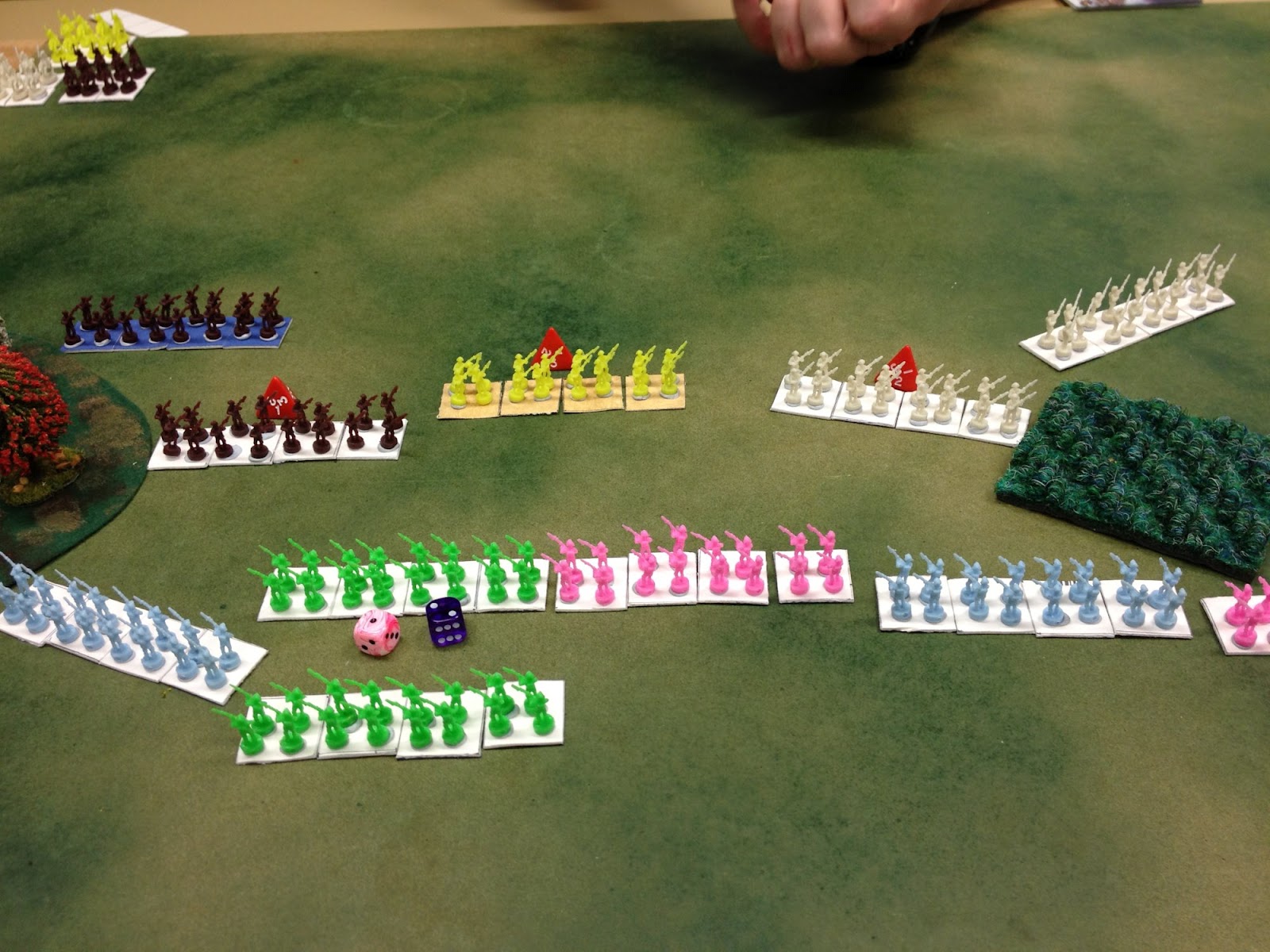
As trailered in the previous post, we played another game of Maurice last night. We used the same armies as before - basic troop quality, six infantry, three cavalry and three artillery per side - but this time we used nothing but figures from a single (pirate copy) Risk set, based on 1" squares. This allowed us to play on a 4' x 3' area (5' x 2' would have probably worked better), and gave the armies a more consistent feel. I do plant to paint these figures - at some stage.

Of course, both armies couldn't be Riskovia (it's too classy a place for a civil war), so for the purposes of this report I have dubbed the Riskovian's foes the Duchy of Sans-Couleur, in recognition of the fact that they were made up of the beige, brown and yellow figures from the game. The Riskovians went into battle arrayed in pale blue, luminous green and hot pink.

I played the Riskovians, Ralph played the Duchy and Caesar tried to keep order and look up rules as we bombarded him with questions.

The battlefield from the Riskovian perspctive - some hills to the right, a ploughed field and a large wood.


The Riskovians looked particularly colourful:


Their cavalry looked eager, and up for a fight:


The dour forces of the Duchy of Sans-Couleur. Truly beneath contempt:


The Riskovian artillery took long-range pot-shots at the Duchy's infantry. On the hill in the distance can be seen the Sans-Couleur artillery doing the same to the Riskovian infantry. Indeed this was the entire Sans-Couleur plan apparently; put the artillery on the hill and shoot:


After a cautious start the infantry of both armies slowly edge towards each other:


Sadly the ever dapper Geoff wasn't present so I couldn't tale the obligatory picture of him. Instead you get this picture of Caesar refereeing:


The infantry got stuck into a firefight, with the Riskovians having a slight edge:


After several turns of musketry, a Sans-Couleur infantry unit broke. The Riskovian Pink Grenadiers followed it up with a bayonet charge, routing a second Sans-Couleur unit:


The Duchy activated their cavalry. Two units swung across the table to plug the gap in their centre, whilst one turned to block the Riskovian cavalry. In the first melee it saw them off:


The Pink Grenadiers had turned onto the flank of a Sans-Couleur infantry unit, and routed it with musketry. But it was now under attack by massed cavalry:


A fierce melee saw the cavalry driven off. As they swirled in disarray, accurate musketry routed the Duchy's White Hussars:


On the flank the Riskovian cavalry got their act together and routed the Sans-Couleur delaying unit. At that point with the Duchy five units down and Riskovia yet to lose anything, the Duke conceded the game:


This was a much more satisfying game than our first one, as neither of us made any gross errors in deployment. It developed into a traditional 18th century fire-fight, with lines of infantry blazing away at each other for extended periods of time. I had a slight edge there, having drawn a good hand of cards enabling me to modify my firing with Deadly Volleys, whilst disadvantaging Ralph's with Thick Smoke. Taking fewer hits meant I could concentrate less of rallying, and rebuild my hand more quickly as well.

I was lucky to get a good selection of event cards as well. Ralph activated his cavalry with a Clear Instructions card, but I had one too and was able to counter by activating my cavalry as well. Another event card allowed me to move one of Ralph's infantry units such that it masked his artillery and put his infantry line out of easy command for a turn. Yet another card allowed me to activate two groups of units just after the first breakthrough in the centre, giving me the chance to quickly exploit it. And, finally, as Ralph's cavalry charged into the Pink Grenadiers, the Grenadiers instantly rallied, meaning they fought at full efficiency. So the key to the Riskovian victory was good cards played at the right moment.

We're eagerly looking forward to our next game. And, at some stage, I will look at painting the figures.

Related Posts Plugin for WordPress, Blogger...