Monday, 7 May 2018

Deep Space D-6

"You are the Captain of the USS Crypsis - a RPTR class starship on routine patrol of the Auborne system when a distress call was received. Upon warping in you quickly realize it was a trap! With the help of your crew, you must survive until a rescue fleet appears."

This is the premise of Deep Space D-6, a rather nice solitaire boardgame which I downloaded and printed the other day. Whilst there is a commercial version, with lovely components, extra rules and a selection of ships to play, there is a basic print and play version available as a free download for anyone who wants to give it a go. You can find it via its Boardgame Geek entry.

The mechanisms are relatively straightforward. Your ship's crew is represented by a hand of six dice. At the start of each turn you roll them, and the results dictate which crew assignments are available that turn - 1's are Command, 2's are Tactical, 3's are Medical, 4's are Science and 5's are Engineering. Command dice can alter other dice, tactical shoot at things, medical heal crew, Science operate the shields and keep threats at bay and Engineering repair damage. 6's are bad, representing Threats appearing on the scanners. Threats are the key to the game; there is a deck of 36-42 cards (depending on how many 'Nothing Happens' cards you choose to put in), mostly containing some obstacle or attacking enemy ship. Threats can be external (you shoot at them) or internal (issues on the ship which cause problems until specific crew specialisms resolve them). Each turn you automatically gain a new threat, and the scanners may generate more if you roll lots of 6's. So you roll your dice, assign the crew to deal with existing threats and issues according to what you have available, generate a new threat and then resolve all currently active threats to see if they damage the ship. You win if you get through the deck and eliminate all active external threats. It's not easy (even with all the 'Nothing Happens' cards in play). You lose if your ship reaches zero hull or, if at the start of a turn, you have no crew dice available to roll.

I played  quick game last night just to try it out, didn't put much effort into it and got destroyed about a third of the way through the deck.

This evening I decided to give it a proper go. This was the start of my first game, with the initial threats consisting of an Assault Cruiser and an approaching Meteoroid. The latter is a nasty threat, since it automatically scores damage, even if you destroy it. All you can do is attempt to delay it so that when it hits your ship has enough hull and shields to take the impact.


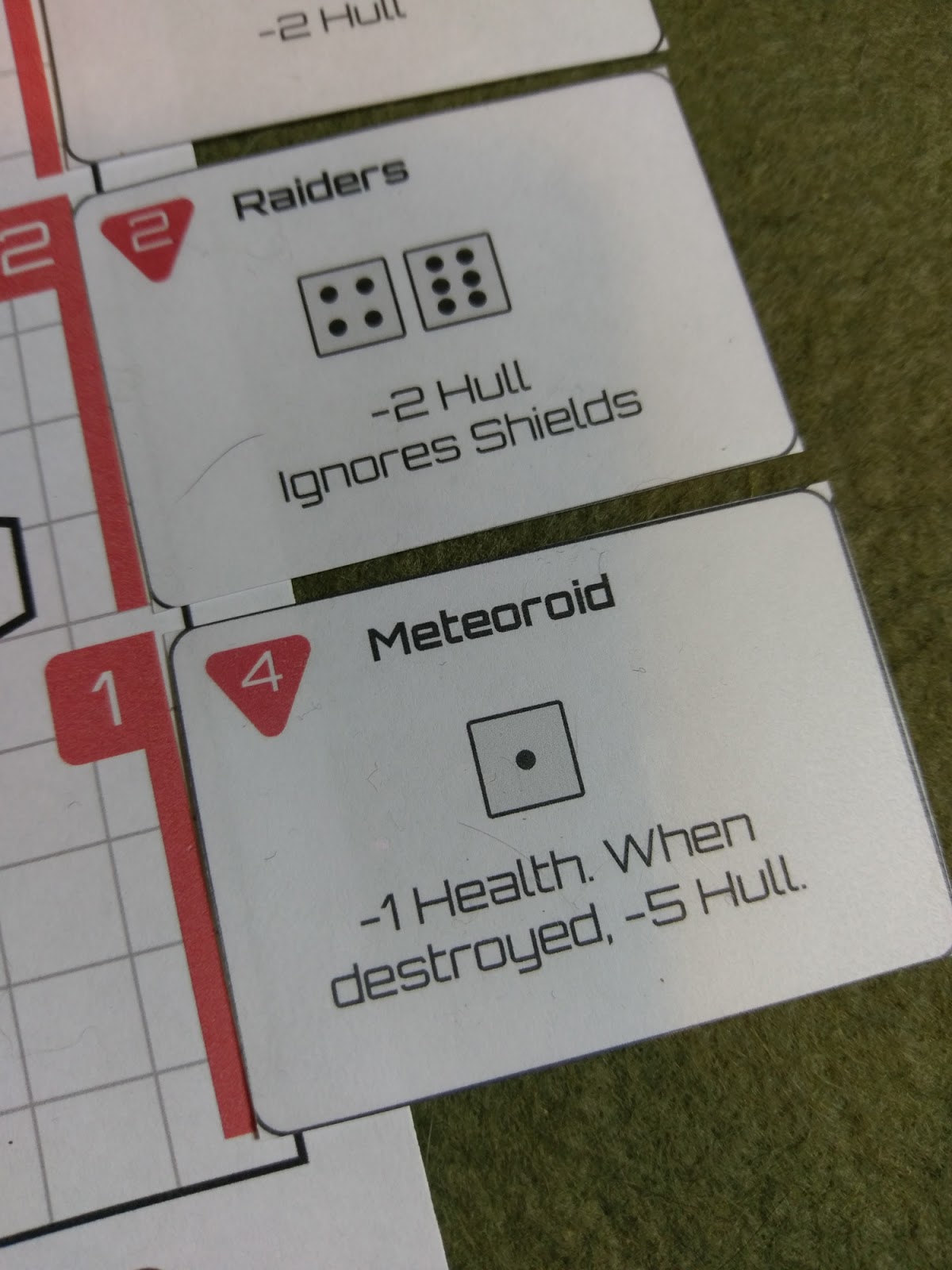
Things quickly went pear-shaped, as a lack of Tactical rolls prevented me from engaging the steadily accumulating wave of Threats. You can see a series of die results on each card. A single Threat Die is rolled, and every Threat card with the resulting number on it is activated. At this stage rolling a one was not a good thing to happen. I rolled a one.


The next turn I rolled another one, and the meteoroid smacked into my virtually crippled ship, destroying it. I was less then halfway through the deck.

My second game went slightly better, but again, I couldn't stop the Threats accumulating. The end came when I was attacked by a horde of cloaked threats (the card to the left of the main board), a double-whammy for which I was ill-prepared.


The third game went far more smoothly. I got great rolls virtually all of the way through, which meant I was able to stay on top of the Threats. Yes, there were a few hair-raising moments, but I eventually made it to the end of the deck. At this point things could still have gone badly; I still had to resolve the remaining three external threats (the cards on the right), but three of my six crew dice were in the infirmary, and one of the others was 'Distracted' ("Show me some more of this thing you Earth-people call 'kissing' ..."). If the two active dice I had ended up locked in the scanners I would run out of crew and lose.


I didn't. I managed to stay on top of the Threats, recover my crew from the Infirmary ("I'm a doctor, not a random-number generator!"), save my sixth crew dice from the amorous clutches of a purple-haired alien sex-goddess and finish off the last of the attacking enemy ships just as the relief force arrived.


Of course, having defeated the game with the 'Nothing Happens' cards in the deck, I now feel honour-bound to remove some or all of them and increase the difficulty.

The game takes about thirty minutes to play, and occupies a reasonably small footprint, so is a perfect lunchtime game. I thoroughly recommend it.

Munera In The Country

I have little gaming to report this weekend; whilst the weather has been unseasonably nice we squeezed in a last camping trip. Winter will be on us soon, so that will be it until September. So this was our view.


And this.


I packed a few gladiators, though, and did some more testing for 'Munera Sine Missione'. I didn't get as much done as I'd have liked; despite the nice weather, at this time of year you don't get a lot of daylight to play by, and the fact that we were camped in a hollow surrounded by trees and hills didn't help there at all.


Anyway, I think the basic rules are in a state I'm happy with, and we just need to tweak and finalise some of the campaign rules and other trimmings.

Friday, 4 May 2018

Let The Feathers Fly

Once again I appear to be the owner of a phone that gives up taking pictures one picture into an evening's gaming. So this is it; the only photo I got of last night's DBA games with Peter.


In both of them I defended with Maya against Aztecs. In both the Maya lost.

In the game pictured, the Maya (bottom) moved forward to try and hit the Aztecs before they could deploy properly, but they were themselves stuck in woods and a gully and weren't moving quickly. My left took out his right, but before I could exploit it, the Aztec hordes in his centre wiped out my centre. He picked up a 4-3 win.

In the second game we were fighting on a near empty field, thanks to some unlucky terrain placement rolls. Peter's best warriors were on his left, and slowly drove mine back, until they hit the gully there, where I was able to turn things around and score some kills. I was also successful killing Aztecs in the centre, but they were worthless hordes. Meanwhile he was slowly totting up kills with his general, and eventually won 4-2. This was a wonderfully scrappy game, with both lines fragmenting due to pursuits fairly rapidly, and a lot of shuffling around in order to regain overlaps or block breakthroughs.

So the Maya have lost all three of their encounters with the Aztecs. Time to think about some cunning plans.

Tuesday, 1 May 2018

Munera Sine Missione - Update


Things have been quiet on this blog for a few days. But they haven't been quiet on the gaming front, as Victor and I have been thrashing out the latest set of changes to Munera Sine Missione. The changes are sufficiently radical for us to consider the next update, when it comes, to be a brand new version - Version 3.0.

So what can you expect to see?

Well, the core game is still basically the same, so rest assured that you'll still recognise the game of gladiator mayhem you all know and love. The biggest change we have made is to how Fatigue is managed. this had a knock-on effect into most of the core mechanisms, and gave us a chance to tweak and refine a few things there that weren't quite right. At present Fatigue is something a gladiator acquires randomly, and is a figure which is compared against their stamina to see if the gladiator is fresh, tired or exhausted. In the new version a gladiator chooses to acquire fatigue in order to gain extra actions. However instead of the fatigue total being compared against the current stamina, there are situations where the fatigue is cancelled and converted into stamina loss. In other words we have (i) made fatigue something a gladiator chooses to acquire and (ii) combined the effect of wounds and fatigue into one statistic. This opens up extra choices for gladiators, and makes the bookkeeping easier as well.

The new mechanism allowed us to change some of the Special Events, and also led to a method by which lighter gladiators can try to avoid damage by dodging. Where possible we have tried to use existing die rolls to drive any changes, rather than adding in new tests and checks. This means that the game still flows quickly and smoothly.

The recent optional rules for the referee and for gaining favour with the crowd have been made part of the core game, as we found they add significant colour and that we weren't ever playing without them.

As ever, there have been several tweaks to weapons in order to better depict a range of gladiators from all eras of Rome's history. Victor has put together a list of gladiators by historical era, including their equipment and opponents. But the game still allows you to quickly determine game stats for any figures you have, even if they aren't entirely historical.

The biggest addition will be the campaign rules. Victor and I have both developed a system for running a single gladiator through a career in the arena, and regular readers of this blog will know that I have a similar system which allows a number of players to run gladiator schools against each other. Neither system is that sophisticated, but we thought that the time had come to at least include them in the published rules.

I'm very excited about these changes, and think they greatly improve the game, whilst keeping its original flavour. And you'll be the first to know when we finally get around to publishing it.

Friday, 27 April 2018

Maurice Part Deux

Gary and Caesar finally played their Maurice campaign game last night, completing the first round of our campaign. Gary defended with the Ottomans against Caesar's massed French columns.


Gary seemed to get off to a good start. His laid a dense terrain, which gave his massed artillery plenty of protection, but which also allowed his irregular cavalry to do a sweeping flank attack on the French infantry as it advanced. Caesar managed to stabilise that situation, and eliminate the Ottoman horse, but had suffered plenty of casualties. Eventually, though, his infantry met that of the Ottomans and a firefight ensued in which the Ottoman line slowly crumbled. Gary's artillery did fearful execution on the French cavalry, but it was too late; the Ottoman morale collapsed, giving the victory to the French.

Gary was part of the same alliance as Peter and myself, so his loss means that the war continues into another round, with many of us fighting with armies made up of hastily-raised conscript replacements. So the next set of battles look like they might be interesting, but short.


John and I played a few bouts of Munera Sine Missione, with a lot of the rules being in my head owing the the major rewrite they are currently undergoing. We ran a campaign setup, but only played out the first Games. We each had a school of six gladiators; two lights, two mediums and two heavies, putting two challengers forward each and matching them with something suitable from our school for a total of four bouts in the 'day'.

My fancy arena really only allows one bout at a time, so that's what we did.

Bout 1: I used Hero against the spear-using Alumnus. Alumnus couldn't get past Hero's armour, whilst the heavier gladiator slowly wore his opponent down and eventually forced him to his knees to seek mercy from the crowd. They spared him, but that meant there was a negative modifier on the next gladiator to appeal that day.


In the second fight, I used Bremusa against the dimachaerus Spiculus. Bremusa is armed as a thraex, but since Spiculus doesn't have a shield her sica simply counted as a sword (In MSM a sica is specialised for circumventing the opponent's shield).

This was probably the best fight of the evening, with both gladiators ending up wounded. It went for ten rounds before Bremusa finally backed Spiculus into the arena wall and ran him through, mortally wounding him.


The third fight was between the heavily armoured contra-retiarius Telamonius and my school's retiarius, Titan. Titan got in an early net attack, but couldn't exploit it before Telamonius cut his way free. However his agility mostly kept him out of trouble, and eventually he managed to fell Telamonius with a mighty blow from his trident. I'm hazy on what happened at that point (our notes are incomplete), but I think poor Telamonius fell victim to the crowd's desire for blood.


Finally John used the lasso-using Gracchus against my other heavy gladiator who, at some point, has lost his name label, so was called Anonymous for the evening. John had appalling AP rolls in this fight, to the point where Gracchus simply gave up trying to use his lasso, dropped it and fought with his trident in both hands, just so he stood a chance of getting in some attacks.


Anonymous had better luck with Action Points, and took down Gracchus fairly quickly. Like Alumnus, he was backed against the wall, and killed instantly.


We called a halt at that point, since John had lost all four bouts and decided that his school would close in shame.

The various changes we were trying out seemed to work OK, but Victor and I have plenty of work to do tying everything together, agreeing on terminology and (in at least one case) agreeing on mechanisms.

There were actually two other games on offer last night; Peter and Geoff played a big DBA game, whilst Ralph ran some Team Yankee at the back of the room. I didn't get photos of either of those games, so you'll just have to take my word for it.
Related Posts Plugin for WordPress, Blogger...