Friday, 10 May 2019

Burlesque Update #1

Not Us
(But how we think we'll look. In our dreams)
I have survived Week One of my six-week sabbatical from Thursday Night Wargaming!

As I wrote about the other week, my latest set of burlesque lessons are taking place on Thursdays, and I can't be in two places at once. This will be the longest break I've taken from club wargaming in about ten years.

Strangely I spent last night learning about cannons which, as well as being big guns, are also a form of group dance move not unlike an elegant Mexican wave. Anyway, our group routine features two cannons as part of the opening section, and once we have the timings sorted we'll look fantastic. Maybe even a bit glamorous.

As well as being part of the group performance I am also learning how to develop a solo burlesque routine, which I will be performing in front of a real, paying, audience in early June. So far this is going surprisingly well. I have the overall structure mapped out, I have all of the costume elements organised, and have choreographed about half of it to a stage where I can actually practice it. In the most recent class for the 'Feature Performers' (for such I am) I did what I have so far in front of other people (the rest of the class) for the first time, and apparently it's looking good. So I'm quite thrilled. Bear in mind I have little performance background (some amateur dramatics about 20 years ago) and no dance experience aside from some rock & roll lessons a few years ago. So this is virgin territory for me.

Back to games in my next post, I promise.

Wednesday, 8 May 2019

Simplicity In Hexes

Jay at 'Numbers, Wargaming and Arsing about' has been fiddling with Neil Thomas. Or, at least, his 'Simplicity in Practice' (SiP) rules. He's simplified them, tweaked them, and then squished them onto a six by six hex-grid in order to play 'One Hour Wargames' (OHW) scenarios with them.

That sounds fun, I hear you say. Well you can grab a bit of the action HERE - rules, scenarios and even a link to a mini-campaign.

I dragged out my Memoir '44 board this evening, as well as my paper Liberation figures, and gave them a try. I did Scenario 4, in which one side begins defending a hill, and both sides are looking to control it by the end of the battle. I used Bolivar's Republicans against the Royalists.

Bolivar's troops ended up defending - a unit of foot and some guns they'd rustled up from who knows where defended the hill. Marching to their aid were two more units of foot and a couple of groups of light infantry.

The attacking Royalists fielded fur units of foot, a unit of light infantry and and some cavalry.


The defenders in position.


The Royalists got stuck in right away with a cavalry charge on the guns which was repulsed. In the background you can see some playing cards; I used the optional rule for playing-card activation, rather than the straight Side A Moves, the Side B Moves sequence.


As the Royalists formed up to attack, the Republican reinforcements appeared. The stones behind the units mark hits; unit is removed when it has taken four.


A charge routed the Republican foot from the hill. I must confess that I found the rules for charges and moving adjacent to enemy units a little vague, and will almost certainly work out some clarifications of my own.


The Republicans were forming a decent line, with swarms of skirmishers on their left (including local indians), and their line in the centre. The guns held out on the hill for ages, repulsing a couple of attacks, but were eventually forced to pull back and were then finished off by the Royalist cavalry.


There was a lot of shooting, which saw both sides lose units. The Royalists managed to grab the hill, but their unit there was unsupported, and their other troops looking a little shaky. The Republicans had a couple of shaky units as well, but two fresh ones were still ready to enter the fray.


More firing saw the Royalists routed from the hill, and Republican skirmishers grab the feature. The Royalists were now down to a single unit of light infantry.


Needless to say it didn't last long. The Republicans won in 9 turns.


The game played out in under an hour (including setup), and the rules held up pretty well; certainly on a par with the original OHW rules. Jay has done a great job translating SiP to hexes; I look forward to seeing what he, and others, do with this conversion.

Monday, 6 May 2019

More Little Tanks

I was off work with a cold today, but plodded my way through another game of What A Tanker to keep my brain from seizing up. This time I pitted a Sherman and a Honey against a Pz III and a Luchs. I wanted to try out the fast, light tanks, as well as the rapid-fire trait the autocannon on the Luchs has. 

The light tanks are fast. The Honey quickly got behind the Pz III.


Meanwhile the Luchs found itself the cover of some woods, and the Pz III tucked in behind a hill, leaving the Sherman in a tricky position.


However the Pz III couldn't ignore the Honey to its rear. And the Honey couldn't acquire its target for love nor money. Now in danger, the Honey ran for it. The Pz III fired a parting shot, but rolled a critical fail, allowing the British tank to escape.


Unfortunately the Luchs had moved round in support, and raked the Honey with autocannon fire, damaging its drive. The crippled Honey now had a gauntlet to run, and only one leg to do it on.


Whilst the Luchs hunted the damaged Honey, the two larger tanks went hull-down facing each other. Both needed three acquisition dice in order to start shooting, but neither could manage it.


The Luchs continued to wear down the Honey, which was forced to turn to face.


With the Honey now down to one command dice, the Luchs abandoned it and quickly moved onto the flank of the Sherman's position.


The Sherman attempted to reverse into the woods behind it, but the Pz III quickly changed position, and reached into a hull down position on the hill the Sherman had previously occupied, before pounding the Sherman with a series of well-aimed shots. The Luchs scored some non-penetrating hits from the flank as well, and soon the Sherman was immobilised, so I called the game.


The Honey had occupied a hilltop position behind the Luchs, but with only one command dice was going to take several turns to repair and get back into the action.


Light tanks are very quick, since they can always move if they want to, and add to any movement they actually roll. The autocannon was also very useful; it can fire consecutive shots without reloading, and the Luchs was very lucky with the rolls required, allowing it to fire a couple of well-aimed shots each turn. Not deadly on their own, using wild dice to increase penetration proved useful.

Now I need a nap.

Sunday, 5 May 2019

A Little Tanker

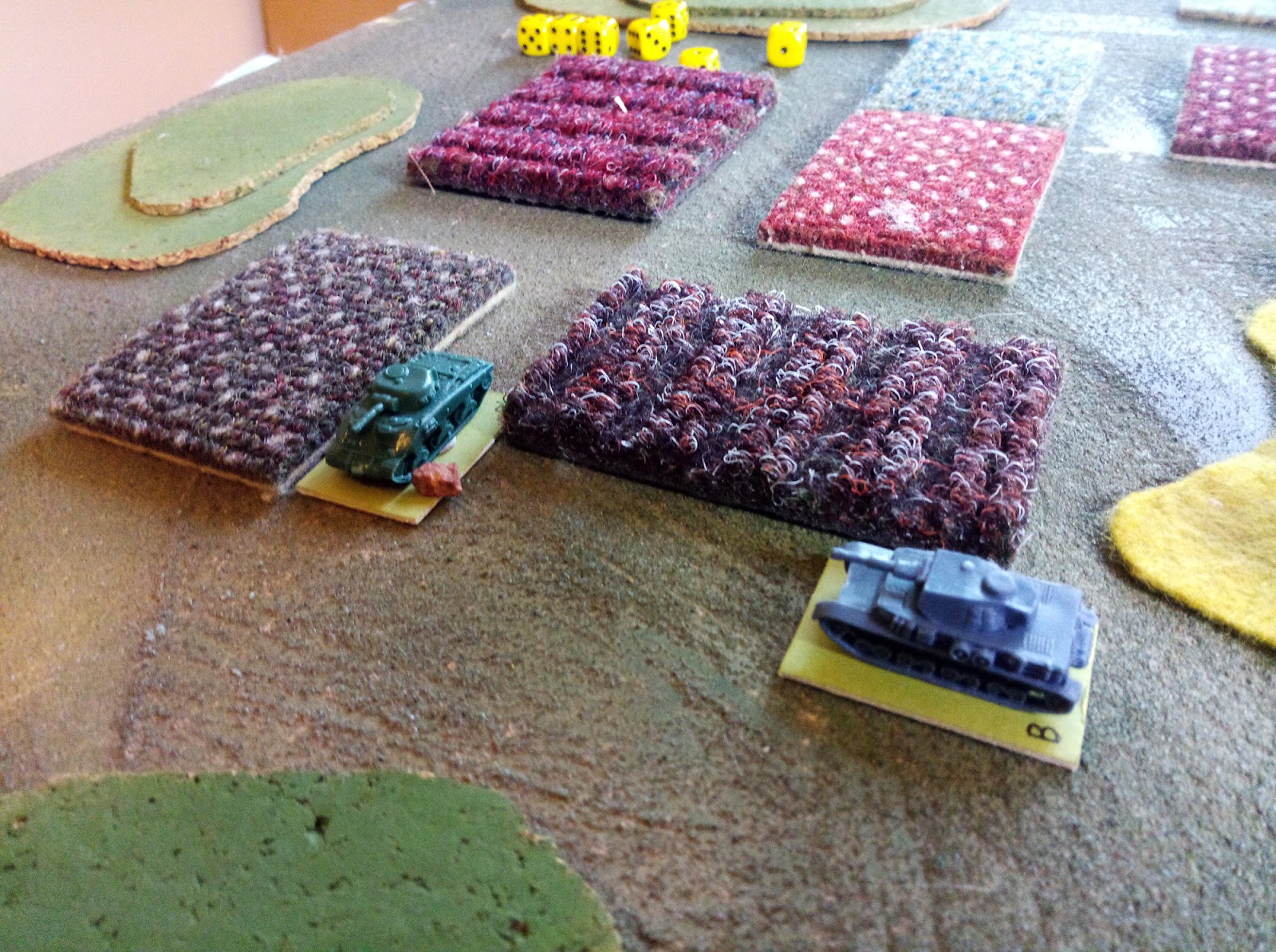
Up until now we've played What A Tanker with big models on a large table, but I wondered how it might work with smaller models on a smaller board. So I set up a quick game this afternoon, using the 1/285th scale models from Memoir 44 on a 2' square board and converting all distances to cm.
I ran a Sherman (Strike 6 Armour 6) against a Pz IV (Strike 7 Armour 5). The terrain was an area of low-walled field, woodland and surrounding hills and rises.


The Pz IV made a run for the fields, exposing its flank to the Sherman. At this range, and with a large number of low obstacles in the way, this wasn't as dangerous as it could have been.


The Sherman seized initiative, and got into a good firing position, but couldn't get in a shot against the German tank.


The Pz IV closed rapidly ...


... and got in a shot. The Shermans tracks were damaged.


The Pz IV moved to the cover of a field boundary, whilst the Sherman backed up. But the damaged tracks made its movement very slow.


With the Sherman struggling to move, the Pz IV closed the range.


The Pz IV took up position behind a wall, whilst the Sherman tried to back into the woods. The Sherman scored a hit on the Pz IV, but it was easily recovered temporary damage.


The Pz IV took a risk; grabbing the initiative, it turned and ran along the lane between the fields.


Making use of an exceptional number of movement dice it was able to move around the Sherman's flank through the woods.


The damaged Sherman struggled to respond, and the Pz IV worked into its rear. But neither tank now had acquisition.

(You'll notice a small stone against the tanks in some pictures. None of the turrets rotate, so I used the stone to mark which way the gun was facing, unless it was facing forward.)


Before the Pz IV could acquire the Sherman, the British tanks (yes, it's a British one) managed to roll some decent command dice and drove off as fast as it could.


The Pz IV pursued, and the Sherman was forced to turn at bay. Another hit saw its optics damaged.


Both tanks tried to acquire, aim and shoot, the Sherman slowly backing away to spoil the German tank's aim. But the Pz IV rolled a blinding Doube Six hit - two extra strike dice! Plus another from a wild dice. With ten strike dice being rolled against it, the Sherman was doomed.


Or not. Only a 5 or 6 scored damage. The German's shot bounced off the Sherman's armour. As did the next.


The Sherman also scored a hit, but again it failed to penetrate the German's armour. Rapidly losing the action, the Sherman tried to make a run around the German flank.


And made it. But it suffered another hit on the way, damaging its turret again.


Before it could line up a shot, the Pz IV fired again, and scored a fourth permanent hit on the Sherman. With the Sherman only one having one command dice left, I called the game a German win.


The game worked pretty well at this scale, although the dense terrain on the middle made it tricky for either side to get an easy shot at the other. The game delivered some exciting moments, and I'll try it again when I get a chance.

Friday, 3 May 2019

What A Massive Tanker


Seven People!

Thirteen Tanks!

Our Biggest Game of 'What A Tanker' So Far!

The truth is the game was thrown together at the last minute, loads of people turned up wanting to play and we had an eclectic, random assortment of vehicles to choose from. We went for a 1943 Russian setting whis allowed us to use a wide variety of vehicles.

On the Russian side we had: 2 x T34/76, 1 x KV, 1 x SU76, 1 x SU85, 1 x Lend-Lease Sherman, 1 x Lend-Lease Valentine

The Germans were simpler: 2 x Stug III, 2 x Pz III and 2 x Marder


Here's one of the Marders. I ran them both. No turret rotation to keep track of, which is good but, on the downside, the crew are always exposed to enemy fire.


Everybody in the middle went for cover, although I think what was available favoured the Russians more than the Germans - they had good strong walls and we just had hedges.


We lost a Stug early on. And one of my Marders took so many hits that the crew abandoned it.


The rest of our force moved to engage the Russians, who were now happily ensconced in nice defensive positions.


The Panzer IIIs managed to set themselves up too, but terrible activation dice meant that they never really got to shoot at anything.


My surviving Marder, however, had an amazingly lucky time of it. I pushed it out into the open in order to get a shot at the SU76, accepting that doing so would probably see it blown away by the supporting Russian tanks. But it wasn't; they either missed or their shots were deflected by the armour. I plugged away at the SU76 until it was destroyed, and then engaged and seriously damaged one of the T34s as well. The plucky tank-destroyer was still operational when we called time on the game, albeit with some minor damage.


One of the Panzer IIIs wasn't so lucky, destroyed by a long-range shot from the Sherman.


The other Panzer III? Very lucky. A T34 had worked its way behind it, and got in two clean shots. Both hit but, amazingly, bounced off the armour.


Anyway, by this stage we'd been playing for over three hours, so we called it a night. The Russians were still mostly fighting fit, whereas the Germans were down to a Marder and a PzIII. And maybe a Stug; my memory has deserted me here. And all of them had reduced dice pools. We called it a Russian win, but we think they very much had the edge in terms of kit; the points system in 'What A Tanker' doesn't really reflect actual capabilities we feel.

Was it fun? Oh yes. Loud and boisterous, according to the people on the adjacent table. And it ran smoothly, despite the size of the game.
Related Posts Plugin for WordPress, Blogger...